How can AI help Alaska evaluators write teacher evaluations under the Alaska teacher standards?

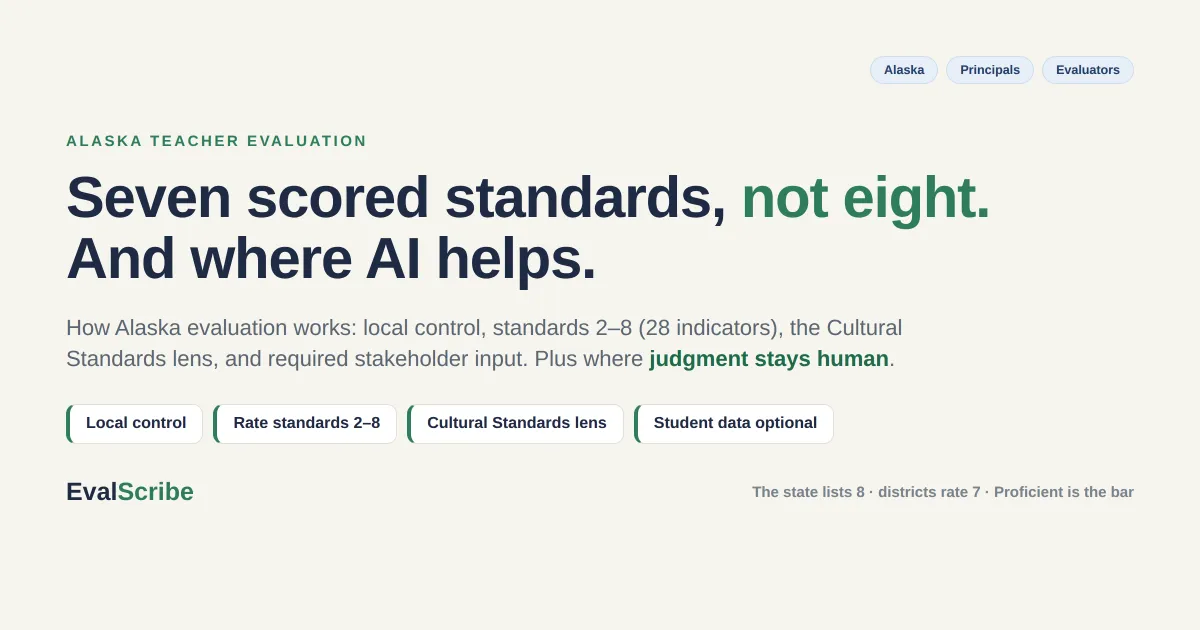
Alaska is one of the few states that writes its teaching standards directly into regulation and then tells districts exactly what to do with them. The professional content and performance standards at 4 AAC 04.200(b) describe eight standards for a teacher's practice. 4 AAC 19.010(b) directs districts to rate a teacher exemplary, proficient, basic, or unsatisfactory on standards two through eight — seven scored standards — while considering the Cultural Standards for Educators in every one of those ratings. AI can meaningfully help with the observation write-up: mapping evidence to the right standards, drafting best-fit ratings, and generating feedback in the standards' own language. What it can't do is tell you which performance standards your board actually adopted, because Alaska hands that decision to each district.
What Alaska's teacher evaluation landscape actually is
Alaska splits the work between the state and the district in a way that's worth understanding before you use any tool, including this one.
The state sets the content standards. 4 AAC 04.200(b) lists eight content standards for teachers, each followed by the performances that reflect attainment of the standard. 4 AAC 19 — Evaluation of Professional Employees — then tells districts what to do with them: rate teachers on standards (b)(2) through (b)(8), on a four-level scale, considering the cultural standards at 4 AAC 04.200(f).
The district builds the instrument. Under AS 14.20.149(a), a school board adopts a certificated employee evaluation system covering every certificated employee except the superintendent, designed in consultation with students, parents, community members, classroom teachers, bargaining units, and administrators. Under 4 AAC 04.205(b), the district establishes its own performance standards for each state content standard — it may adopt the state's performance standards as written, modify them to fit district goals, combine them into broader standards, or add its own. And under 4 AAC 19.030(b)(3), a district may use a nationally recognized evaluation framework approved by the department that aligns with 4 AAC 04.200 — which is why you'll find Danielson- and Marzano-derived instruments running in Alaska districts on top of the state's own standards.
So the state's standards are the floor and the common language. The specific instrument on your desk was built by your board.
The seven scored standards and twenty-eight performance indicators
Here is what districts rate, straight from the regulation.
Standard 2 — A teacher understands how students learn and develop, and applies that knowledge in practice (2 indicators): accurately identifying and teaching to students' developmental abilities; and applying learning theory to accommodate differences in student intelligence, perception, and cognitive style.
Standard 3 — A teacher teaches students with respect for their individual and cultural characteristics (3 indicators): incorporating the student's and local community's culture into instructional strategies; identifying and using strategies and resources appropriate to individual and special needs; and applying knowledge of Alaska history, geography, economics, governance, languages, traditional life cycles, and current issues to the selection of strategies, materials, and resources.
Standard 4 — A teacher knows the content area and how to teach it (5 indicators): the academic structure of the content area, its tools of inquiry, central concepts, and connections to other domains; the developmental stages by which learners gain mastery, with strategies to assess and advance a student's stage; a wide repertoire of strategies including instructional technology; connections to other content areas and to situations outside school; and staying current in the content area and demonstrating its application to life, work, and community.
Standard 5 — A teacher facilitates, monitors, and assesses student learning (5 indicators): organizing and delivering instruction based on student characteristics and curricular goals; creating, selecting, and adapting instructional resources; using a variety of assessment strategies that reinforce learning and help students reflect on their own progress; maintaining records and communicating progress to students, parents, administrators, and other audiences; and reflecting on assessment information and adjusting practice.
Standard 6 — A teacher creates and maintains a learning environment in which all students are actively engaged and contributing members (4 indicators): a stimulating, inclusive, safe community where students take intellectual risks and work both independently and collaboratively; communicating high standards and clear expectations; using a variety of classroom management techniques; and helping students understand their role in sharing responsibility for their learning.
Standard 7 — A teacher works as a partner with parents, families, and the community (5 indicators): regular, meaningful classroom-to-family communication; working with parents and families to support learning; participating in schoolwide efforts to reach the broader community; connecting school and classroom activities to student homes, cultures, workplaces, and the community; and involving families in setting and monitoring learning goals.
Standard 8 — A teacher participates in and contributes to the teaching profession (4 indicators): maintaining a high standard of professional ethics; keeping content knowledge and best practice current; engaging in instructional development that improves classroom, school, or district programs; and communicating, working cooperatively, and building professional relationships with colleagues.
Twenty-eight performance indicators across seven standards. Notice how much of Standard 3 and Standard 7 is place-specific in a way that no national framework replicates: Alaska history and traditional life cycles are named in the regulation itself.
The standard that doesn't get scored
Standard 1 — a teacher can describe their philosophy of education and demonstrate its relationship to their practice — is part of Alaska's professional standards, but it isn't part of the rated set. 4 AAC 19.010(b) scopes district ratings to the content standards at 4 AAC 04.200(b)(2)–(8), and Standard 1 sits outside that range.
That doesn't make it irrelevant. It carries real weight in preparation contexts, where the beginning-teacher standards at 4 AAC 04.200(e) apply and a candidate is expected to state a philosophy supported by research and demonstrate practices consistent with it. And a district may evaluate a teacher on additional standards it has adopted, so a local instrument could bring philosophy back in deliberately. But by default, in a district teacher evaluation, standards two through eight are what get rated.
This is exactly the kind of detail a general-purpose chatbot gets wrong, because it looks at eight standards and scores eight standards.
The four-level scale — and why Proficient is the professional standard
Alaska's scale is unsatisfactory, basic, proficient, exemplary, and it comes with consequences attached, which is unusual and worth reading carefully.
Unsatisfactory is performance consistently below the requirements of the standard. Under 4 AAC 19.010(g), a rating of unsatisfactory on one or more content standards means the teacher has not met district performance standards for purposes of AS 14.20.149(b)(6), (e), and (f) — the plan-of-improvement provisions.
Basic is novice or below-standard performance where improvement is necessary and expected. Under 4 AAC 19.010(h), a rating of basic on two or more content standards obligates the district to provide support and assistance on those standards, and permits the district to place the educator on a plan of professional growth — a plan the evaluating administrator develops in consultation with the educator, with clear performance expectations, ways performance can improve, and a district-determined duration. If, at the end of that plan, performance on the standards in question is still not proficient or exemplary, 4 AAC 19.010(i) lets the district move to a plan of improvement.
Proficient is the expected professional level: fully and consistently meeting the requirements of the standard.
Exemplary describes practice that consistently and significantly exceeds the requirements — masterful, student-directed, leadership-oriented.
The critical point for evaluators is the same one that shows up in every well-built framework: Proficient is not a middling score. It is the level the standards are designed for a competent, effective teacher to consistently reach. Rating a strong teacher Proficient is accurate, not stingy. And Alaska adds a wrinkle most states don't: 4 AAC 19.030(b)(4) expressly permits a district to require a more experienced teacher to perform at a higher level than a teacher with less experience. What earns Proficient in year two may not in year twenty, if the district's system says so.
The Cultural Standards for Educators are a lens, not a box
4 AAC 04.200(f) sets out four cultural standards for educators, and 4 AAC 19.010(b) directs that districts shall consider them when rating a teacher on the content standards. They are not a ninth standard with its own score. They condition every rating.
A culturally-responsive educator incorporates local ways of knowing and teaching into their work; uses the local environment and community resources on a regular basis to link teaching to students' everyday lives; works closely with parents toward a high level of complementary educational expectations between home and school; and recognizes each student's full educational potential and provides the challenges necessary to reach it.
Read those next to the content standards and the overlaps are obvious. The first two live inside Standard 3 and Standard 4's real-world connections. The third lives inside Standard 7. The fourth touches Standards 2, 5, and 6. Which means the evidence for cultural responsiveness in an Alaska write-up should appear throughout the document, not in an isolated paragraph at the end — and an evaluator in a village school where elders, subsistence calendars, and local place names are part of the instructional day is documenting something the regulation explicitly asks about.
The procedural requirements around the write-up
Alaska specifies the process in more detail than most states, and every one of these requirements shapes what the documentation needs to do.
Frequency. AS 14.20.149(b) requires a district's system to include at least two observations a year for each nontenured teacher, at least an annual evaluation of each tenured teacher who met district performance standards the previous year, and an annual evaluation for each administrator. A district may limit its evaluations of tenured teachers who have consistently exceeded the standards to one evaluation every two school years.
Basis. 4 AAC 19.030(a)(1) requires the evaluation to be based on the evaluator's observation of the employee in the workplace. The district must also consider information provided by students, parents, community members, teachers, and administrators under AS 14.20.149(b)(7), must notify those groups of the opportunity to provide it, must supply a form or electronic means for doing so, and — this one matters for how you write — must indicate what information the district used and the source of that information.
Draft review. The district must give the employee a copy of or access to the draft evaluation at least 24 hours before it becomes final, must inform them of the right to review and comment in writing before it's final, may not retaliate for those comments, and must have both the evaluator and the employee sign the evaluation.
Who evaluates. AS 14.20.149(c) limits evaluation to a person holding a type B certificate (or a site administrator supervised by one) who is employed by the district as an administrator and has completed training in the district's evaluation system. 4 AAC 19.030(c) also requires the evaluation to be approved by a holder of an administrative certificate.
Confidentiality. AS 14.20.149(h) makes evaluation information not a public record and not subject to disclosure, though the employee is entitled to a copy and may waive confidentiality.
Plans of improvement. A tenured teacher whose performance doesn't meet district standards gets a plan of improvement under AS 14.20.149(e), developed in consultation with the teacher, lasting not less than 90 and not more than 180 workdays unless shortened by agreement, with at least two observations during it. If performance again falls short at the end, the district may nonretain under AS 14.20.175(b)(1).
After the observation: where the work piles up
Add those requirements together and the picture is clear. An Alaska evaluation isn't a form. It's a document that has to map fragmentary notes to evidence across seven standards and twenty-eight performance indicators, carry a defensible best-fit rating on a four-level scale for each one, show what information was used and where it came from, hold cultural responsiveness as a thread throughout rather than an afterthought, and survive being handed to the teacher 24 hours before it's final with a written right of reply — all under a statute where the ratings drive plans of professional growth, plans of improvement, and nonretention.
The observation takes a class period. Turning it into that document takes far longer. And an Alaska principal is often doing it for a whole building, in a district where the nearest colleague to compare notes with may be a plane ride away.
Where AI helps with the Alaska write-up
The strongest fit between current AI and this work is the mapping-and-translation problem. An observer captures notes in fragments and needs to sort them across the standards and render them in the regulation's own language.
AI handles three parts of that reliably. First, it turns fragmentary notes into coherent, evidence-anchored prose in the standards' voice — the difference between "kids used the fish camp example to explain the ratio" and a sentence tied to Standard 3's requirement that a teacher incorporate the local community's culture into instructional strategies. Second, it maps evidence to the relevant standards, including evidence that supports more than one — a small-group task built around local place names can touch Standard 3's cultural incorporation, Standard 4's connection of content to situations outside school, and Standard 6's inclusive learning community at once. Third, it maintains consistency across all twenty-eight indicators so the write-up reads as one coherent picture of a teacher's practice rather than seven disconnected paragraphs.
For Alaska specifically, the payoff is in holding the scale's logic steady — drafting Proficient as the genuine professional standard it is, keeping Exemplary tied to practice that consistently and significantly exceeds the standard — and in keeping the cultural-responsiveness thread anchored to what was actually observed rather than gestured at.
Where AI doesn't help — and what stays with the evaluator
The honest scope here is narrower than most AI marketing implies, and Alaska's structure defines the edges.
AI cannot tell you which performance standards your district adopted. 4 AAC 04.205(b) lets your board modify, combine, or add to the state's performance standards, and 4 AAC 19.030(b)(3) lets it run a department-approved national framework instead. A tool built around the state's standards is not automatically your board's instrument. That has to be confirmed locally.
AI cannot conduct the observation. 4 AAC 19.030(a)(1) requires the evaluation to be based on the evaluator's own observation in the workplace. There's no version of this where a tool watches the classroom.
AI cannot be the evaluator. AS 14.20.149(c) and 4 AAC 19.030(c) restrict who may evaluate and who must approve the evaluation. Those are people with certificates and training, not software.
AI cannot weigh student learning data. Under 4 AAC 19.030(d) a district may incorporate it, and must confer with educators to identify appropriate data by subject and grade. That's a separate district process outside the observation write-up.
AI cannot judge Exemplary from a tidy paragraph. Exemplary is meant to be rare and specific. Confirming that practice consistently and significantly exceeds the standard requires the evaluator's judgment about what was actually in the room.
And AI cannot supply the context an Alaska evaluator brings — that this is a two-teacher school where one person covers six grade levels, that half the class was out for a subsistence opening, that the teacher arrived in October from out of state and is three months into learning the community. That context shapes a rating in ways no chatbot reconstructs.
What AI does well, it does well. Pasting notes into a general chatbot functions as a glorified search engine — but for documentation that maps evidence to the real standards, indicates its sources the way 4 AAC 19.030(a)(3) asks, and holds up when a plan of improvement follows, the gap between "sounds polished" and "actually defensible" is real.
Observable evidence: what each standard looks like in practice
Each standard surfaces in things an observer actually sees and notes.
Standard 2 shows in lesson complexity matched to demonstrated developmental level, accommodations for IEPs and English learners built into the instruction rather than bolted on, varied modalities for different cognitive styles, and a teacher who can articulate the developmental reasoning behind a choice. Standard 3 shows in materials and examples that reflect the local community, place-based connections to local geography and traditional practice, Alaska history and current community issues woven into content, and strategies adjusted for individual and special needs.
Standard 4 shows in accurate, disciplinary use of content, academic vocabulary taught and used precisely, multiple strategies inside a single lesson, explicit cross-subject and real-world connections, and technology that deepens learning rather than decorating it. Standard 5 shows in multiple assessment methods visible in the room, formative data driving an adjustment you can watch happen, specific feedback tied to learning goals, and students who can say where they stand against the target.
Standard 6 shows in routines and transitions students already know, engagement that reaches past the willing volunteers, students attempting hard things without shame when they miss, and an environment where every student's identity is visible and respected. Standard 7 shows in evidence of two-way family communication, families involved in goal-setting rather than only informed of results, community members and elders used as instructional assets, and activities connected to home life and local work. Standard 8 shows in substantive PLC participation, professional learning visibly applied, reflection that cites specific evidence, and ethics modeled in confidentiality and advocacy.
Across every standard, the signature of Exemplary is the same: the students carry it. Self-assessment, peer accountability, intellectual risk-taking as a norm, and a teacher whose influence reaches past their own room.
Common scoring mistakes under Alaska's standards
Even experienced Alaska evaluators fall into a few recognizable patterns.
The first is scoring Standard 1. Eight standards are listed; seven are rated. Philosophy of education isn't part of the district teacher evaluation unless the district added it.
The second is treating Proficient as a disappointment. Four-point scales invite reading the third level as merely adequate. Alaska's regulation designs Proficient as full, consistent attainment of the standard. Reserve Exemplary for what the label says: consistently and significantly exceeding it.
The third is treating the cultural standards as a box to tick. They're a lens the regulation applies to every content-standard rating. Evidence for them belongs throughout the write-up.
The fourth is confusing the state's standards with your district's instrument. Your board adopted the system; 4 AAC 04.205(b) let it modify, combine, or add. Assuming the state text is your rubric produces write-ups that don't match what your district's process requires.
The fifth is thin sourcing. 4 AAC 19.030(a)(3) requires the district to indicate what information it used and where the information came from, and 4 AAC 19.030(a)(2) requires it to consider input from students, parents, community members, teachers, and administrators. A write-up that shows only the observer's impressions is missing something the regulation asks for.
The sixth is forgetting the experience clause. 4 AAC 19.030(b)(4) permits a district to hold a more experienced teacher to a higher level. If your district's system uses that provision, the same evidence doesn't automatically produce the same rating for a first-year and a twentieth-year teacher.
Alaska in context — a state that legislates the standards and delegates the instrument
Alaska sits at an interesting point on the national spectrum. Many states publish teaching standards as a guidance document and designate a single scoring instrument. Alaska does close to the opposite: it puts the standards and the rating scale into regulation, where they are legally binding, and then delegates the actual instrument to each school board.
The result is a strong common language with real local variation on top of it. Every Alaska district is rating teachers exemplary, proficient, basic, or unsatisfactory on the same seven content standards, considering the same four cultural standards. But the performance standards underneath — the specific things a district decided attainment looks like — were set locally, and some districts layered a national framework on top.
There's also something distinctive in the content itself. Very few states name their own history, geography, languages, and traditional life cycles inside a teaching standard. Alaska does, in Standard 3, and then reinforces it with cultural standards that ask educators to use the local environment and community as regular instructional resources. Whatever else is true about evaluation in Alaska, the standards are unmistakably about teaching in Alaska.
How EvalScribe handles Alaska's standards
EvalScribe is built around the actual regulation — the seven scored content standards from 4 AAC 04.200(b)(2)–(8) and all twenty-eight performance indicators — rather than approximating them with generic teaching-evaluation prose. Every standard carries the regulation's own language across the four levels, the look-fors an observer watches for, and the distinctions that separate adjacent ratings. An evaluator captures notes by typing, dictating, or photographing handwriting (Smart Scan OCR converts it to text), and EvalScribe maps that evidence to the relevant standards and drafts best-fit ratings and feedback in the standards' voice — treating Proficient as the professional standard it is, reserving Exemplary for practice that consistently and significantly exceeds the standard, and surfacing cultural-responsiveness evidence across the write-up where 4 AAC 19.010(b) puts it.
A few honest scope notes, because Alaska's structure demands them. First, EvalScribe is built around the state's standards; whether that matches your board's adopted instrument depends on what your district did under 4 AAC 04.205(b) and 4 AAC 19.030(b)(3), and we're glad to hear from you at [email protected] if yours reads differently. EvalScribe also ships Danielson, Marzano, Stronge, CEL 5D+, NIET, and Kim Marshall for districts running a national framework. Second, EvalScribe supports the write-up. The observation, the community input, the 24-hour draft review, the signatures, the student learning data, and every employment decision that follows remain yours.
Beta testers report saving 30 to 60 minutes per evaluation versus writing the documentation traditionally. Across a full evaluation cycle — with two observations required annually for every nontenured teacher — that adds up to dozens of hours back. More detail on the Alaska workflow is available at evalscribe.com/alaska, and district leaders planning a rollout across a borough can start at evalscribe.com/district.
Frequently asked questions about Alaska's standards and AI
Are the state's standards the same as my district's evaluation rubric? Not necessarily. The state sets the content standards and the four-level scale in regulation; your board adopts the evaluation system and establishes district performance standards, which may modify, combine, or add to the state's.
Why isn't Standard 1 scored? 4 AAC 19.010(b) scopes district ratings to the content standards at 4 AAC 04.200(b)(2)–(8). The philosophy-of-education standard sits outside that range for teacher evaluation, though a district may add standards of its own.
How do the Cultural Standards for Educators factor in? Districts are directed to consider them when rating a teacher on the content standards. They condition every rating rather than carrying a score of their own.
Does AI replace evaluator judgment? No. EvalScribe drafts best-fit ratings and evidence-based feedback; the evaluator reviews, edits, and finalizes every rating — and under AS 14.20.149(c), only a trained, certificated administrator can do the evaluating in the first place.
Does EvalScribe incorporate student learning data? No. That's an optional district process under 4 AAC 19.030(d), separate from the observation write-up.
Does it handle the 24-hour draft review? EvalScribe produces the draft you share. The review, the teacher's written comments, and the signatures are your process.
Where can I read the official sources? The standards are at 4 AAC 04.200; district performance standards at 4 AAC 04.205; the evaluation rules in 4 AAC 19; the statute at AS 14.20.149. DEED keeps the statutes, regulations, and the Cultural Standards for Educators together at education.alaska.gov.
If you're evaluating teachers in Alaska on the state's content standards, see how EvalScribe handles the seven-standard, twenty-eight-indicator workflow at evalscribe.com/alaska. If you're leading the rollout for a district, start at evalscribe.com/district.
References
Alaska Administrative Code, 4 AAC 04.200 — Professional content and performance standards
Alaska Administrative Code, 4 AAC 04.205 — District performance standards
Alaska Administrative Code, 4 AAC 19 — Evaluation of Professional Employees (19.010 purpose and scope; 19.030 evaluation procedures)
Alaska Statutes, AS 14.20.149 — Employee evaluation
Alaska Department of Education & Early Development, Statutes and Regulations — Educator Evaluation, including the Cultural Standards for Educators
Related articles
How can AI help Hawaii evaluators write teacher evaluations under the EES?
EvalScribe vs. general AI platforms: a practical comparison for K-12 evaluators
Page maintained by Anthony D. Neely, Ph.D. — practicing K-12 educator with nearly 20 years in the classroom, 2025–2026 Walker County Distinguished Teacher of the Year, and co-founder of EvalScribe. Framework details verified against 4 AAC 04.200, 4 AAC 04.205, 4 AAC 19, and AS 14.20.149.
Last reviewed: July 17, 2026.