How can AI help Connecticut evaluators write teacher evaluations under the CCT Rubric?
July 01, 2026 • 17 min read

How can AI help Connecticut evaluators write teacher evaluations under the CCT Rubric?
Connecticut evaluates teachers on the CCT Rubric for Effective Teaching (2017) — the Common Core of Teaching instrument used under Connecticut General Statutes § 10-151b, now within each district's educator evaluation and support plan under the Connecticut Guidelines 2023. It defines four domains and twelve indicators, each scored holistically on a four-level scale from Below Standard to Exemplary. AI can meaningfully help with the write-up: mapping observation evidence to the right indicators, drafting holistic ratings, and generating feedback in the rubric's own language. What it can't do is produce the overall evaluation rating (the CCT observation is one part of a district's broader evaluation and support plan), supply the non-observation evidence some domains rely on, or replace the evaluator's holistic professional judgment.
What Connecticut's teacher evaluation system is
Connecticut's evaluation runs on two connected pieces. The CCT Rubric for Effective Teaching is the rubric that describes quality practice, and the district's educator evaluation and support plan is what puts the rubric to work alongside other measures. (Before the 2023 Guidelines, the state model was branded SEED — the System for Educator Evaluation and Development — a name many Connecticut educators still use.) The legal backbone is Connecticut General Statutes § 10-151b, which requires that the superintendent of each board of education annually evaluate, or cause to be evaluated, each teacher.
The rules of the road live in the state's evaluation guidelines. The Performance Evaluation Advisory Council (PEAC), established under C.G.S. § 10-151d, recommends the guidelines to the State Board of Education, and at the district level a Professional Development and Evaluation Committee (PDEC) — required by C.G.S. § 10-220a — helps shape and adopt the local evaluation plan. That two-layer design, state guidelines plus local plans, is why two Connecticut districts can run recognizably different processes while both anchoring to the same CCT Rubric.
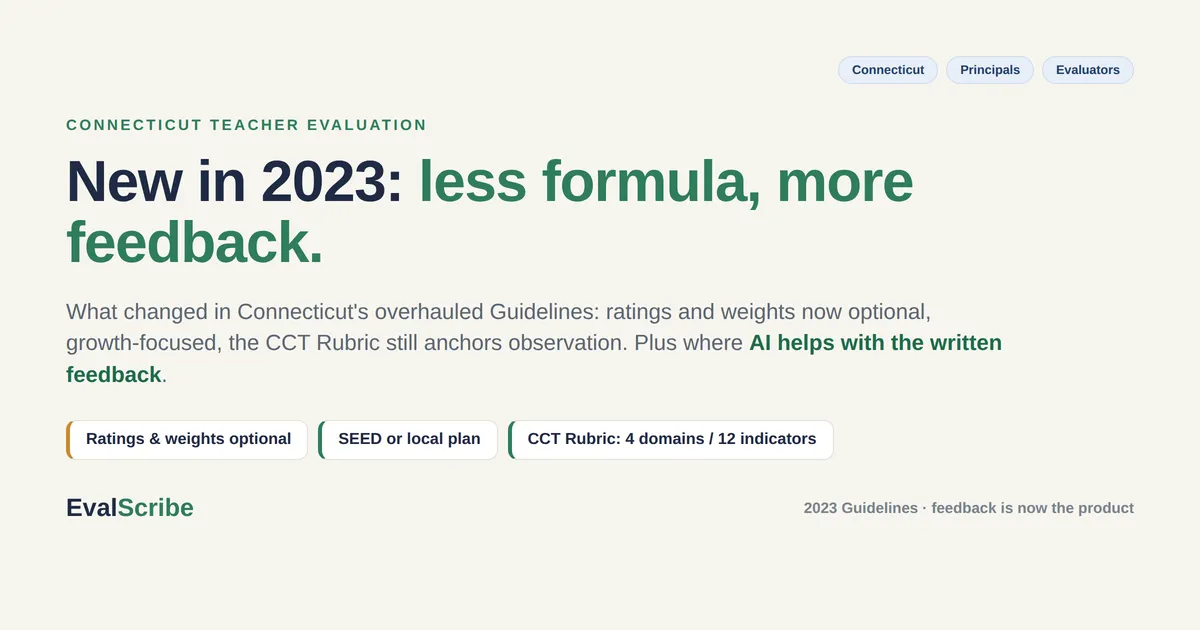
One important piece of current context: Connecticut adopted new Guidelines for Educator and Leader Evaluation and Support in 2023, replacing the 2017 Guidelines, with implementation beginning in the 2024-25 school year (under C.G.S. § 10-151b as amended by Public Act 23-159). The 2023 Guidelines center evaluation on a Professional Growth Cycle, move toward a multiple-measures model, and give districts more latitude — a district may continue to use the CCT Rubric or adopt one that is aligned with or tied to an externally referenced standard. The CCT Rubric for Effective Teaching 2017 remains the state-published instrument, and it remains the reference point most Connecticut district plans build on.
The four domains and twelve indicators
The CCT Rubric organizes teaching into four domains, each with three indicators — twelve in all:
Domain 1 — Classroom Environment, Student Engagement & Commitment to Learning. 1a, creating a positive learning environment; 1b, promoting developmentally appropriate standards of behavior; 1c, maximizing instructional time.
Domain 2 — Planning for Active Learning. 2a, planning content aligned to standards, prior knowledge, and appropriate challenge; 2b, planning instruction to cognitively engage students; 2c, selecting appropriate assessment strategies.
Domain 3 — Instruction for Active Learning. 3a, implementing instructional content; 3b, leading students to construct meaning and apply new learning; 3c, assessing student learning, providing feedback, and adjusting instruction.
Domain 4 — Professional Responsibilities & Teacher Leadership. 4a, engaging in continuous professional learning; 4b, collaborating to develop and sustain a professional learning environment; 4c, working with colleagues, students, and families to sustain a positive school climate.
Two of those domains — 1 and 3 — describe what an evaluator sees in the room, and they carry the weight of a classroom observation. Domains 2 and 4 describe planning and professional practice that a single observation can't fully capture; they draw on planning artifacts, pre-conference conversations, and professional evidence gathered across the year. That distinction matters for how the write-up comes together, and it's a place where evaluators sometimes expect a classroom observation to do more than it can.
The four-level scale and the real Exemplary bar
Each indicator is rated on four levels: Below Standard, Developing, Proficient, and Exemplary.
Below Standard signals practice that is ineffective, absent, or counterproductive. Developing means foundational practice is present but inconsistent or only partially effective. Proficient is the expected professional standard — practice that is consistently effective and responsive to students. Exemplary sits above Proficient, but the way it sits above Proficient is the single most misunderstood feature of the CCT Rubric.
Exemplary is not Proficient performed with more energy. The rubric defines it as all the characteristics of Proficient, plus two specific shifts: students take greater ownership of their learning, and the teacher leads and extends practice beyond the classroom. In indicator after indicator, the Exemplary descriptor moves the agency to the students — they establish and maintain norms, they generate their own questions and strategies, they help develop and interpret success criteria, they self-monitor and give each other feedback. A brilliantly delivered, teacher-driven lesson is the picture of Proficient. Exemplary is when the students are driving.
The other thing to hold onto is that indicators are scored holistically. The evaluator determines one best-fit level per indicator from the preponderance of evidence across its attributes, rather than checking off every attribute line by line. A teacher doesn't need to hit every phrase in the Proficient column to earn Proficient; the question is where the weight of the evidence lands.
The observation cycle and multiple measures
The CCT Rubric is the observation-of-practice engine, but a Connecticut evaluation is built from more than observation. Under the earlier SEED-era model, the teacher-practice rating from the CCT instrument historically determined about 40% of a teacher's summative rating, sitting alongside student outcomes — including teacher-developed Student Learning Goals/Objectives (SLOs) — and stakeholder feedback such as parent or peer surveys. The overall rating combined those measures according to the district's plan.
The 2023 Guidelines loosen the rigid arithmetic of that model in favor of multiple measures, a Professional Growth Cycle, and professional judgment, which means the exact weighting a district uses is increasingly a local decision rather than a fixed statewide formula. For an evaluator, two things stay constant regardless: the CCT observation produces indicator-level ratings and evidence-based feedback, and those ratings are one input into a larger evaluation and support picture — not the whole of it. Any tool that drafts CCT observation ratings is helping with a real and heavy part of the job, but it is not producing the overall rating itself.
After the observation: where the work actually piles up
The observation is the part Connecticut evaluators are trained for. The writing that follows is the part that consumes the calendar.
A single CCT evaluation asks the evaluator to take a page of walkthrough shorthand and turn it into evidence mapped across twelve indicators, decide a holistic best-fit level for each one, and draft feedback in the rubric's language that a teacher can actually act on — all while keeping the Exemplary bar honest and the Proficient descriptions from blurring into vague praise. Multiply that across a caseload, layer in the pre- and post-conference cycle the district's plan expects, and the documentation becomes the single largest time cost in an evaluator's year.
The observation takes thirty minutes. Turning it into a defensible, rubric-aligned write-up takes far longer. And the thing that makes a CCT evaluation defensible — specific evidence, mapped to the right indicators, rated at the right level in the rubric's own terms — is exactly the thing that makes the paperwork heavy.
Where AI helps with the CCT write-up
The strongest fit between current AI and CCT evaluation work is the mapping-and-translation problem. An evaluator captures notes in fragments and then has to sort them across twelve indicators and render them in the rubric's language.
AI handles three parts of that reliably. First, it turns fragmentary notes into coherent, evidence-anchored prose in the CCT's voice — the difference between "kids restated success criteria in own words" and a sentence tied to indicator 3c about students self-monitoring against communicated criteria. Second, it maps evidence to the relevant indicators across all four domains, so a single observation of a well-run small-group task lands where it belongs — potentially touching 1a, 3b, and 3c at once. Third, it maintains consistency across the twelve indicators so the write-up reads as one coherent portrait of a teacher's practice, with the same rigor applied top to bottom rather than fading after the first few indicators.
For Connecticut specifically, the payoff is in holding the rubric's own distinctions steady — drafting to the real Developing-versus-Proficient line, and to the real Exemplary bar of student ownership, rather than the generic "good/great" gradient a general chatbot defaults to.
Where AI doesn't help — and what stays with the evaluator
The honest scope is narrower than the marketing on most AI tools suggests.
AI cannot compute the overall rating. The CCT observation is one part of a district's evaluation and support plan; the overall combination of practice, student outcomes, and feedback happens under the district's plan — not in a drafting tool.
AI cannot supply the evidence Domains 2 and 4 rely on. Planning quality and professional responsibilities draw on artifacts, pre-conference conversations, and a year's worth of professional practice that no single classroom observation captures. AI can help you write up what you have; it can't manufacture evidence you didn't gather.
AI cannot own the Student Learning Goals/Objectives or the stakeholder feedback. Those components sit outside the observation rubric and belong to the teacher and evaluator.
AI cannot make the holistic determination. Deciding where the preponderance of evidence lands on a four-level scale — and defending that placement in a post-conference — is professional judgment. AI drafts a suggested best-fit rating; the evaluator decides.
And AI cannot supply the local context a seasoned Connecticut evaluator brings — that this teacher took on a combined section mid-year, that this district's PDEC reads certain evidence a particular way, that a lesson fell during a hard week. Local context shapes the rating in ways no chatbot reconstructs.
What AI does well, it does well. Pasting notes into a general chatbot works fine as a glorified search engine — but for CCT documentation that maps evidence correctly, holds the rubric's level distinctions, and survives a post-conference and the district's evaluation process, the gap between "sounds polished" and "actually defensible" is wider than the polish suggests.
Observable evidence: what each domain looks like in practice
Each domain surfaces in things an evaluator actually sees and notes.
Classroom Environment (Domain 1) shows in consistently positive and respectful interactions, students willing to take intellectual risks, behavioral expectations that are reinforced with little lost learning, and routines and transitions that maximize instructional time. Planning for Active Learning (Domain 2) shows in plans aligned to the Connecticut Core Standards and built on multiple sources of student data, tasks and questions designed for genuine cognitive engagement, and assessment strategies with observable, measurable success criteria placed at critical points.
Instruction for Active Learning (Domain 3) shows in a clearly communicated purpose, accurate content-specific language, differentiated evidence-based strategies that lead students to construct meaning, individual and group monitoring at critical points, and actionable feedback that visibly adjusts instruction. Professional Responsibilities & Teacher Leadership (Domain 4) shows in reflection that produces real changes in practice, collaboration that improves teaching and learning, adherence to the Connecticut Code of Professional Responsibility for Teachers, and proactive, culturally respectful communication with families.
Across all four domains, the Exemplary evidence has a signature: the students are doing more of the intellectual and social work — questioning, self-assessing, resolving conflict, owning routines — and the teacher's influence extends to colleagues and the wider school.
Common scoring mistakes under the CCT Rubric
Even experienced Connecticut evaluators slip into patterns worth naming.
The first is treating the rubric as an attribute checklist. CCT indicators are scored holistically. Trying to confirm every attribute in the Proficient column before awarding Proficient misreads the instrument and buries the evaluator in bookkeeping.
The second, and the most consequential, is inflating Exemplary. Because Exemplary reads as "the best," it's tempting to award it for excellent teaching. But excellent teacher-driven instruction is Proficient. Exemplary requires the specific shift to student ownership and teacher leadership beyond the classroom. When that evidence isn't present, the accurate rating is Proficient — and calling it Exemplary erodes the rating's meaning.
The third is the Proficient default. When evidence is thin either way, Proficient feels safe. But Proficient means consistently effective, evidence-supported practice — not the mere absence of problems. Thin evidence is a conversation to have, not an automatic Proficient.
The fourth is conflating the observation with the overall rating. A strong or weak CCT observation is one measure; treating an indicator-level rating as the teacher's final verdict skips the multiple-measures design the district's plan is built on.
The fifth is expecting Domains 2 and 4 to be fully observable. Planning and professional responsibilities lean on artifacts and evidence beyond the lesson. Rating them from a single classroom visit alone shortchanges both the teacher and the rubric.
Connecticut in context — district flexibility and a rubric in transition
Connecticut's model blends a strong, well-validated statewide rubric with meaningful local flexibility. The CCT Rubric gives every district a common language for practice, while the district's evaluation and support plan determines how observation combines with other measures into an overall rating. Compared with the most prescriptive states, Connecticut leans harder on holistic professional judgment and on the local PDEC's role in shaping the plan.
That balance is shifting toward even more local latitude. The 2023 Guidelines, phasing in from 2024-25, center evaluation on a Professional Growth Cycle, emphasize multiple measures, and give districts room to use the CCT Rubric or an aligned alternative tied to an externally referenced standard. Connecticut also maintains parallel instruments for other roles: the CCT Rubric for Effective Service Delivery for student and educator support specialists — school psychologists, speech and language pathologists, social workers, and counselors — and the CT Leader Evaluation & Support Rubric for administrators. And the CCT sits on top of the Connecticut Core Standards and the Connecticut Code of Professional Responsibility for Teachers, both referenced directly in the rubric's indicators.
How EvalScribe handles the CCT Rubric
EvalScribe is built around the actual CCT Rubric for Effective Teaching 2017 — all four domains, all twelve indicators — rather than approximating them with generic teaching-evaluation prose. Every indicator carries the rubric's own language across the four levels, the look-fors an evaluator watches for, and the distinctions that separate Developing from Proficient and Proficient from Exemplary. The tool handles the mapping-and-translation problem natively: an evaluator captures notes by typing, dictating, or photographing handwriting (Smart Scan OCR converts it to text), and EvalScribe maps that evidence to the relevant indicators and drafts holistic, best-fit ratings and feedback in the rubric's voice — drafting to the real Exemplary bar of student ownership and teacher leadership rather than handing out top ratings freely.
A few honest scope notes, because Connecticut's model demands them. First, the CCT observation of practice is one part of your district's evaluation and support plan. Under the Connecticut Guidelines 2023, that plan is built around a Professional Growth Cycle and is holistic and locally determined rather than a fixed set of weighted percentages — your district's PDEC sets the specific structure. EvalScribe drafts the observation-of-practice ratings and comments; the overall evaluation and support determination is completed in your district's plan, not the app. Second, Domains 2 and 4 draw on planning artifacts and professional evidence beyond the classroom, and other parts of the plan — such as student learning and stakeholder feedback — stay with the teacher and evaluator. Third, EvalScribe's Connecticut framework is built around the CCT Rubric for Effective Teaching; the Service Delivery rubric and the Leader rubric are separate instruments. And under the 2023 Guidelines, districts have latitude in how the rubric is used — EvalScribe is built around the state-published CCT Rubric for Effective Teaching 2017.
Beta testers report saving 30 to 60 minutes per evaluation versus writing the documentation traditionally. Across a full evaluation cycle, that adds up to dozens of hours back — hours that can go to the post-conference conversation the ratings are meant to support. More detail on the Connecticut workflow is available at evalscribe.com/connecticut.
Frequently asked questions about the CCT Rubric and AI
Where can I read the official CCT and CT Guidelines sources? The primary sources are maintained by the Connecticut State Department of Education: the Educator and Leader Evaluation pages, the CCT Rubric for Effective Teaching 2017, and the Connecticut Guidelines for Educator and Leader Evaluation and Support 2023. Statutory authority is Connecticut General Statutes § 10-151b.
Is the CCT Rubric 2017 still current? Yes. It remains the state-published instrument. The 2023 Guidelines (implementation from 2024-25) give districts more latitude — they may keep using the CCT Rubric or adopt one tied to an externally referenced standard.
Does AI replace evaluator judgment? No. EvalScribe drafts holistic, best-fit ratings and evidence-based feedback; the evaluator reviews, edits, and finalizes every rating and defends it in the post-conference.
Does EvalScribe compute the overall evaluation rating? No. The CCT observation is one part of a district's evaluation and support plan. EvalScribe drafts the observation-of-practice ratings and comments; the overall rating is completed in the district's plan.
What is Exemplary, really? All the characteristics of Proficient, plus students taking greater ownership of their learning and the teacher leading beyond the classroom. Excellent teacher-driven instruction is Proficient, not Exemplary.
What about SLOs, feedback, and the Service Delivery or Leader rubrics? Student Learning Goals/Objectives and stakeholder feedback are separate components outside the observation rubric, handled within your district's plan. The Service Delivery rubric (for SESS staff) and the Leader rubric (for administrators) are separate instruments; EvalScribe's CT framework is built around the CCT Rubric for Effective Teaching.
If you're evaluating teachers in Connecticut on the CCT Rubric, see how EvalScribe handles the four-domain, twelve-indicator workflow at evalscribe.com/connecticut.
References
Connecticut State Department of Education, Educator and Leader Evaluation
CCT Rubric for Effective Teaching 2017, Connecticut State Department of Education
Connecticut Guidelines for Educator and Leader Evaluation and Support 2023 (implementation from 2024-25)
Connecticut General Statutes § 10-151b (annual teacher evaluation), § 10-151d (PEAC), § 10-220a (PDEC)
Related articles
Page maintained by Anthony D. Neely, Ph.D. — practicing K-12 educator with nearly 20 years in the classroom, 2025–2026 Walker County Distinguished Teacher of the Year, and co-founder of EvalScribe. Framework details verified against the CCT Rubric for Effective Teaching 2017 and Connecticut State Department of Education sources.
Last updated on July 28, 2026.