How can AI help Kansas evaluators write teacher evaluations under KEEP?

If you're a Kansas administrator wondering whether AI can help with KEEP evaluations, the honest answer is yes — for one specific part of the process. KEEP, the Kansas Educator Evaluation Protocol, organizes teaching into four constructs, and the professional-practice write-up that documents them is where an evaluator spends the documentation hours. AI can genuinely help there: mapping observation evidence to the right construct and drafting evidence-anchored feedback in the framework's own language. What it doesn't do is measure student growth, combine your two summary ratings into a final summative rating, or decide which evaluation instrument your district adopted. This post walks through where AI helps with KEEP, where it falls short, and what to look for.
What KEEP actually is
KEEP — the Kansas Educator Evaluation Protocol — is the model teacher evaluation system published by the Kansas State Department of Education (KSDE), delivered through the KEEP2 web application. It was built on two principles: that an evaluation system should identify the aspects of teaching that distinguish stronger from weaker practice and can be supported by professional learning, and that it should be flexible enough to work across the full teaching spectrum, from core academic subjects to music, art, physical education, and library media.
One thing to understand up front: Kansas does not mandate a single instrument. KSDE encourages districts to use KEEP, but a district may adopt its own evaluation system as long as it meets the Kansas Educator Evaluation Guidelines and is approved. So while KEEP is the common reference point across the state, the specific instrument in your building is a local decision worth confirming.
The four KEEP constructs
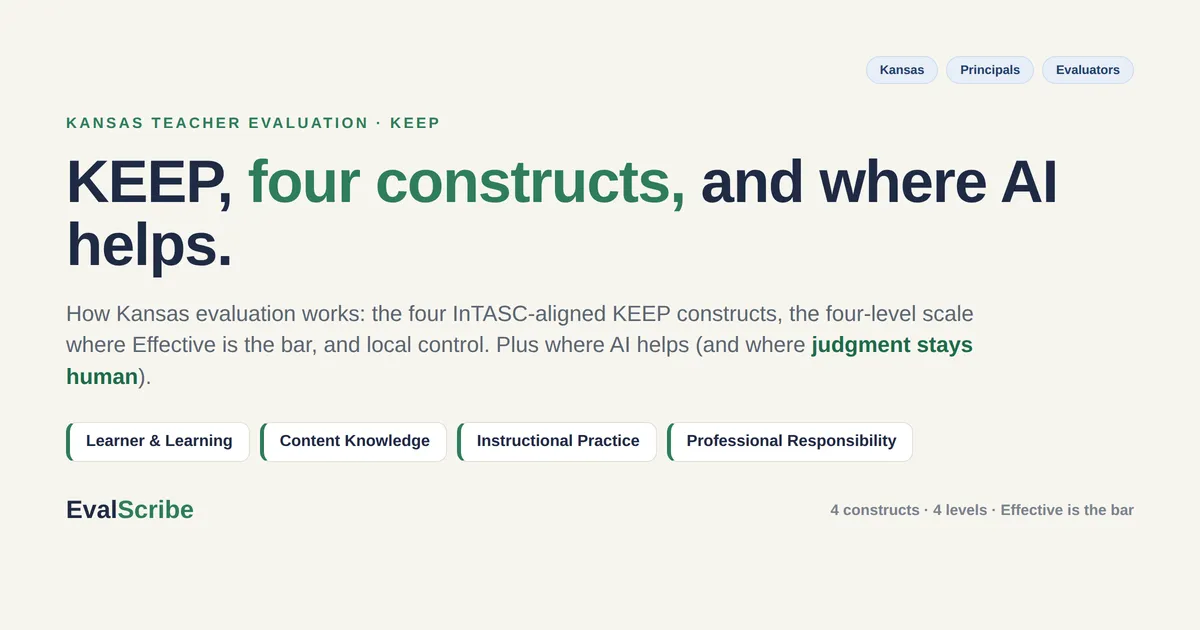
KEEP is organized around four constructs, aligned to the InTASC model core teaching standards. An evaluator gathers multiple sources of evidence and records a rating for each:
Learner and Learning. How the teacher plans instruction based on the learning and developmental levels of all students, recognizes and fosters individual differences to establish a positive classroom culture, and establishes a classroom environment conducive to learning.
Content Knowledge. How the teacher demonstrates thorough knowledge of content and provides a variety of innovative applications of that knowledge.
Instructional Practice. How the teacher uses methods and techniques effective in meeting student needs, uses varied assessments to measure learner progress, and delivers comprehensive instruction.
Professional Responsibility. How the teacher engages in reflection and continuous growth, and participates in collaboration and leadership.
Because the constructs are written around what effective teaching looks like rather than a single subject's routines, they transfer cleanly across roles and grade levels — which is part of why Kansas built KEEP the way it did.
The four-level rating scale
Each construct is rated on a four-level scale. KSDE recommends four levels specifically to add clarity and avoid the tendency to rate everyone in the middle:
Highly Effective — the educator consistently exhibits a high level of performance. Effective — the educator usually exhibits a more than adequate level of performance. Developing — the educator sometimes exhibits an adequate level of performance. Ineffective — the educator rarely exhibits an adequate level of performance.
Each rating must be a valid measure supported by evidence and artifacts. The key indicators in the KEEP rubric describe what each level looks like for a given construct, and the difference between, say, Developing and Effective is specific — it's not a general impression.
Two ratings, one summative: where the observation fits
Here's the structural point that shapes where AI can and can't help. A KEEP evaluation produces two summary ratings — a Professional Practice summary rating (the construct ratings from observation and evidence) and a Student Growth Measures summary rating — and those two combine into a teacher's Final Summative Performance Rating.
The two pieces answer different questions and are gathered differently. Professional practice is about what the evaluator observes and documents against the four constructs. Student growth is measured through multiple valid measures selected by the district; notably, Kansas does not require state assessments for determining student performance — state assessments are just one possible growth measure, used for teachers of tested grades and subjects. The professional-practice documentation is the labor-intensive, write-it-up-for-every-teacher part. The student-growth summary and the final combination are handled in the district's KEEP2 process.
That division matters, because it tells you exactly which part of KEEP an AI drafting tool should touch — and which parts it shouldn't.
After the observation: where the work piles up
The observation itself is familiar work for an experienced Kansas evaluator. The write-up that follows is where the hours go: taking fragmentary observation notes and organizing them as evidence against the four constructs, settling on a defensible rating for each in KEEP's language, and drafting feedback a teacher can act on — then doing it again across a caseload, multiple times a year.
Where AI helps with the KEEP write-up
The strongest fit between current AI and KEEP work is the professional-practice documentation.
AI handles three parts of that reliably. First, it turns fragmentary notes into coherent, evidence-anchored prose in the framework's language — the difference between "kids explained their reasoning to each other" and a sentence tied to Instructional Practice on delivering comprehensive instruction that engages students. Second, it maps evidence to the right construct, including evidence that supports more than one — a well-run discussion can speak to both Instructional Practice and Learner and Learning. Third, it holds consistency across a caseload, so the same quality of evidence lands in similar territory from teacher to teacher rather than drifting with the hour of the night.
For Kansas specifically, the value is holding the write-up to the actual KEEP constructs and key indicators rather than a generic "good teaching" gradient — and doing it consistently enough that the documentation holds up.
Where AI doesn't help — and what stays with the evaluator
The honest scope follows directly from how KEEP is built.
AI cannot measure student growth or calculate your summative rating. EvalScribe and tools like it draft the professional-practice piece — the construct ratings and feedback. The Student Growth Measures summary and the Final Summative Performance Rating are determined in your district's KEEP2 process, according to the measures your district selected and KEEP's combination rules.
AI cannot decide which instrument your district uses. Because Kansas allows KEEP or an approved local alternative, the specific instrument is a local fact to confirm, not something a tool should assume.
AI cannot supply an evaluator's professional and local judgment — what the evidence really shows, how a teacher's year unfolded, how a rating fits the district's context. That stays with the evaluator, who remains the last set of eyes on every rating and comment.
And general-purpose AI in particular has no built-in understanding of KEEP. Paste notes into a consumer chatbot and it will invent construct names, hand out "Highly Effective" freely, and miss the key-indicator distinctions the rubric depends on. For a document that informs retention and professional-growth decisions, the gap between "sounds polished" and "actually defensible" is wider than the polish suggests.
What to look for in an AI tool for KEEP
A few questions worth asking before you commit a tool to this work.
Are KEEP's four constructs and their key indicators built in, or do you have to paste them in every time? If you're providing the framework each time, the workflow is fragile.
Does the tool distinguish the four levels — Highly Effective, Effective, Developing, Ineffective — using KEEP's actual indicators, or does it produce generic high/medium/low scoring?
Does it stay in its lane — drafting professional practice and leaving the student-growth summary and final summative to KEEP2 — rather than pretending to compute a rating it has no basis for?
Where does your observation data live? Is it stored on the vendor's servers, or used to train models?
Can your evaluators use it without an added training burden on top of what KEEP already requires?
How EvalScribe handles KEEP
EvalScribe is built around the four KEEP constructs. An evaluator captures notes by typing, dictating, or photographing handwriting (Smart Scan OCR converts it to text), EvalScribe maps that evidence to the construct it supports, and drafts a rating and evidence-anchored feedback for each — using KEEP's own language across the four levels: Highly Effective, Effective, Developing, Ineffective. Every rating and comment is fully editable before export, and the evidence stays traceable to the note it came from.
Two scope notes, because Kansas's structure calls for them. First, EvalScribe drafts the professional-practice piece; the Student Growth Measures summary and the Final Summative Performance Rating are determined in your district's KEEP2 process, not the app. Second, because Kansas districts may use KEEP or an approved alternative, EvalScribe is built on the four InTASC-aligned constructs and the four-level scale that Kansas systems share; confirm your district's adopted instrument.
Beta testers report saving 30 to 60 minutes per evaluation versus writing the documentation by hand. Across a full caseload and multiple observation cycles, that adds up to dozens of hours back — hours that can go to the feedback conversation the ratings are meant to support. More detail on the Kansas workflow is available at evalscribe.com/kansas.
Frequently asked questions about KEEP and AI
Does EvalScribe support KEEP? Yes. It is built around the four constructs — Learner and Learning, Content Knowledge, Instructional Practice, and Professional Responsibility — and drafts ratings and feedback across the four levels (Highly Effective, Effective, Developing, Ineffective).
Does EvalScribe calculate my summative rating? No. It drafts the professional-practice piece. The Student Growth Measures summary and the Final Summative Performance Rating are determined in your district's KEEP2 process.
Can I use it if my district uses its own system? Often, yes. Kansas allows KEEP or a KSDE-approved alternative, and EvalScribe is built on the four InTASC-aligned constructs and four-level scale that Kansas systems share. Confirm your district's adopted instrument.
Does it require state assessment data? No. Kansas does not require state assessments for determining student performance — they are just one possible Student Growth Measure for tested grades and subjects, handled in KEEP2. EvalScribe works from your observation evidence.
Does AI replace evaluator judgment? No. The observation, the construct ratings, and the professional judgment are yours. AI translates your judgment into construct-aligned documentation.
If you're evaluating teachers in Kansas under KEEP, see how EvalScribe handles the four-construct professional-practice workflow at evalscribe.com/kansas. Questions, or a school or district license? Reach the team at [email protected].
References
Kansas State Department of Education, Educator Evaluations (the recommended four performance levels; multiple measures and student growth)
Kansas State Department of Education, Kansas Educator Evaluation Protocol (KEEP) — Districts (KEEP2 web application)
Kansas Statutes Annotated, Chapter 72 — Schools (educator evaluation policies and timelines)
Related articles
Page maintained by Anthony D. Neely, Ph.D. — practicing K-12 educator with nearly 20 years in the classroom, 2025–2026 Walker County Distinguished Teacher of the Year, and co-founder of EvalScribe. Framework details verified against the Kansas State Department of Education's Educator Evaluations resources and the KEEP protocol.
Last updated on July 28, 2026.