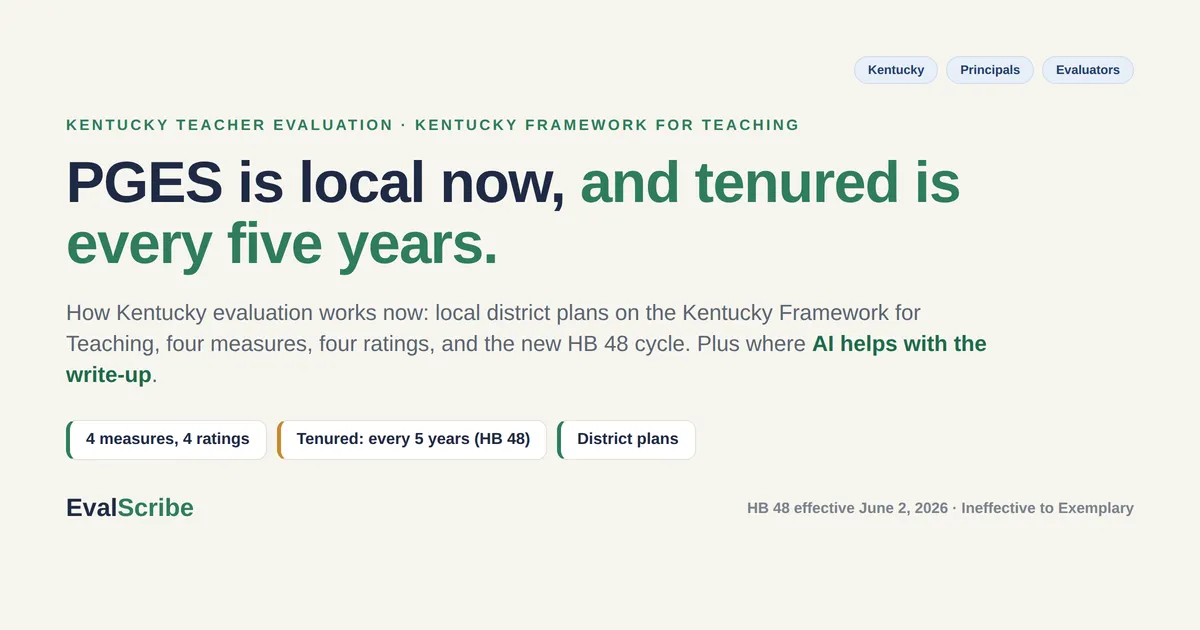
How can AI help Kentucky evaluators write teacher evaluations under the Kentucky Framework for Teaching?
How can AI help Kentucky evaluators write teacher evaluations under the Kentucky Framework for Teaching (KyFfT)?

How can AI help Kentucky evaluators write teacher evaluations under the Kentucky Framework for Teaching?
Kentucky's teacher evaluation system runs on the Kentucky Framework for Teaching (KyFfT) — the Danielson-based rubric that anchors every district's Certified Evaluation Plan under KRS 156.557 and 704 KAR 3:370. What many Kentucky educators still call PGES is now formally the Kentucky Framework for Personnel Evaluation, with four state-required Performance Measures (Planning, Environment, Instruction, Professionalism) and the twenty-two Kentucky Framework for Teaching components underneath. The rating scale runs Ineffective / Developing / Accomplished / Exemplary. AI can meaningfully help with the documentation burden of Kentucky evaluations: translating observation notes into rubric-aligned language, mapping evidence to the four Performance Measures, and producing draft ratings consistent with the framework. AI does not replace evaluator judgment — particularly the Accomplished-to-Exemplary call. AI also doesn't handle Self-Reflection, the Professional Growth Plan, or the Student Learning Focus, which stay with the teacher and evaluator. Where AI lifts the most weight is the observation-based write-up itself.
What Kentucky's teacher evaluation system is
Kentucky's teacher evaluation runs under KRS 156.557 and 704 KAR 3:370, administered by the Kentucky Department of Education (KDE) under Kentucky Board of Education oversight. Every district's evaluation system must meet the Kentucky Framework for Personnel Evaluation — the state's statutory framework — and each district develops its own Certified Evaluation Plan (CEP) through an evaluation committee with equal representation of teachers and administrators (the "50/50 committee"). Initial CEPs are submitted to KDE for approval; subsequent revisions are handled at the local board level.
Unlike states with a single mandatory statewide rubric applied uniformly (Georgia TKES, Texas T-TESS, Florida FEAPs, Tennessee TEAM, Arkansas TESS, North Carolina NCEES, Mississippi PGS), Kentucky uses a district-flexibility model. Every district designs its own CEP through that collaborative 50/50 process. What ties every district's system together is the shared statutory backbone: the four Performance Measures required by state, the Kentucky Framework for Teaching rubric, and the four-level rating scale.
Many Kentucky educators still refer to the whole system as PGES — the Professional Growth and Effectiveness System — which was the branded name of the earlier iteration launched around 2013-2015. The current statutory language has moved to "Kentucky Framework for Personnel Evaluation," and the underlying rubric is the "Kentucky Framework for Teaching (KyFfT)." The rubric backbone has stayed structurally consistent across the naming evolution: four Performance Measures, twenty-two components, four-level rating scale.
The four Performance Measures and twenty-two components
Under 704 KAR 3:370, the four state-required Performance Measures are: Planning, Environment, Instruction, Professionalism. Every Kentucky district CEP must use these measures. Underneath, the Kentucky Framework for Teaching organizes practice into twenty-two components drawn from Charlotte Danielson's Framework for Teaching.
Performance Measure 1: Planning covers six components. 1a (Demonstrating Knowledge of Content and Pedagogy) asks whether the teacher demonstrates deep knowledge of content and how to teach it effectively. 1b (Demonstrating Knowledge of Students) asks whether the teacher understands student backgrounds, interests, readiness, and learning needs. 1c (Setting Instructional Outcomes) asks whether outcomes are clear, rigorous, measurable, and aligned to important learning. 1d (Demonstrating Knowledge of Resources) asks about the teacher's use of available resources to strengthen content access. 1e (Designing Coherent Instruction) asks whether the teacher plans sequences of learning aligned to standards and outcomes. 1f (Designing Student Assessments) asks whether assessments are planned to generate useful evidence of student learning.
Performance Measure 2: Environment covers five components. 2a (Creating an Environment of Respect and Rapport) asks whether teacher-student and student-student interactions are highly respectful. 2b (Establishing a Culture for Learning) asks whether learning is valued and high expectations are evident. 2c (Managing Classroom Procedures) asks whether instructional time is protected through efficient routines. 2d (Managing Student Behavior) asks whether behavior expectations are clear and monitoring is effective. 2e (Organizing Physical Space) asks whether the physical environment supports safety, access, and learning.
Performance Measure 3: Instruction covers five components. 3a (Communicating with Students) asks whether purpose is clear and explanations support student understanding. 3b (Using Questioning and Discussion Techniques) asks about question quality and meaningful discussion participation. 3c (Engaging Students in Learning) asks whether students are intellectually engaged throughout the lesson. 3d (Using Assessment in Instruction) asks whether assessment is used to monitor progress and guide instruction. 3e (Demonstrating Flexibility and Responsiveness) asks whether the teacher adjusts instruction in response to student needs.
Performance Measure 4: Professionalism covers six components. 4a (Reflecting on Teaching) asks whether reflection is accurate, evidence-based, and improvement-oriented. 4b (Maintaining Accurate Records) asks about organized, accurate record-keeping. 4c (Communicating with Families) asks about family engagement in student learning. 4d (Participating in a Professional Community) asks whether the teacher collaborates with colleagues. 4e (Growing and Developing Professionally) asks whether the teacher seeks growth and uses feedback. 4f (Showing Professionalism) asks about ethics, integrity, advocacy, and sound judgment.
Twenty-two components across four Performance Measures. That's the surface area Kentucky evaluators document through observation write-ups.
The rating scale and the Accomplished-to-Exemplary pivot
Kentucky uses four performance levels with Kentucky-specific labels: Ineffective, Developing, Accomplished, Exemplary.
Ineffective indicates unsatisfactory performance — the teacher lacks understanding or application of the standard. Developing indicates basic performance — consistent but mechanical, requires support. Accomplished is the expected professional standard — solid, consistent professional practice. Exemplary indicates distinguished performance — student-centered and highly adapted.
Note the Kentucky-specific choice: the target level is called "Accomplished," not "Proficient" as in most Danielson-based states, and the top level is called "Exemplary," not "Distinguished." That naming difference matters for evaluators used to Danielson's default vocabulary — Kentucky's Accomplished is the same conceptual space as Danielson's Proficient, and Kentucky's Exemplary is Danielson's Distinguished. If you trained in another Danielson state and moved to Kentucky, your calibration reference points transfer; the labels don't.
The hardest call in the Kentucky Framework for Teaching — and the one that most divides evaluators in calibration sessions — is Accomplished versus Exemplary. The two levels share a lot of surface features: organized lessons, engaged students, clear instructional outcomes, respectful classrooms. What separates them is who's doing the work. In Accomplished, the teacher is driving effective instruction. In Exemplary, students have taken over the heavy intellectual lifting — leading discussions, self-assessing against criteria, sustaining the classroom culture, extending the learning independently. The teacher set the conditions; the learners are producing the outcomes.
That's a real distinction, and it's the one most likely to get blurred when an evaluator is writing a summative between observations at 9 p.m. on a Thursday. The specific Level 4 language across the twenty-two components consistently pivots on student ownership: at 2a Exemplary, students "actively sustain the respectful culture." At 3b Exemplary, students "formulate questions and assume responsibility for rich discussion." At 3d Exemplary, students "monitor their own progress." If those specific student-ownership markers aren't present, the correct rating is Accomplished, not Exemplary — even for excellent teacher-directed instruction.
The Kentucky evaluation cycle
Kentucky evaluation operates on a district-defined cycle that meets state requirements under 704 KAR 3:370. Non-tenured teachers receive annual summative evaluation. Tenured teachers receive summative evaluation at least once every five years — House Bill 48 (2025) amended KRS 156.557 to extend the tenured summative cycle from three years to five — with formative work in the intervening years.
Within any given year on the cycle, districts typically require some combination of informal walkthroughs, mini-observations, formal announced and unannounced observations with pre- and post-conferences, and — critically for Kentucky — Self-Reflection, Professional Growth Plan (PGP) with SMART Goals, and the Student Learning Focus document. Those last three components are the teacher's own reflective work; they sit alongside the observation-based rubric evaluation rather than replacing it.
Kentucky evaluators are required to hold certified evaluator training under 704 KAR 3:370. New evaluators complete Initial Certified Evaluation (ICE) — a 2-day, 12-hour EILA-credit training with a passing assessment. Experienced evaluators complete 6 hours of Update Evaluation Training annually. That certification requirement is a defensibility anchor: KDE holds evaluators to specific competency standards before they can rate a Kentucky teacher's performance.
After the walkthrough: where the work actually piles up
The observation itself is the part most Kentucky evaluators trained for. What no one warned them about was the volume of writing that follows.
A single formal Kentucky observation can produce three to seven pages of documentation: rubric ratings across the twenty-two components organized under the four Performance Measures, narrative justifications for each rating, evidence quotations from observation notes, suggested next steps, and language for the required post-observation conference. Multiply that across a caseload of teachers — say thirty teachers with annual summatives for non-tenured teachers plus rotating summatives for tenured teachers on the five-year cycle — and the observation write-up load becomes the biggest single time cost in the Kentucky evaluator's year.
Layer on top: the Self-Reflection review, the Professional Growth Plan conferencing, and the Student Learning Focus review at year-end. Those aren't documentation the evaluator writes independently — they're teacher-authored documents the evaluator conferences on and responds to — but they still eat evaluator time.
This is where the day actually goes. The observation takes thirty minutes. The write-up takes ninety. And the conferencing takes another two hours per teacher across the year.
Where AI helps with Kentucky evaluation write-ups
The strongest fit between current AI and Kentucky evaluation work is the translation problem. An evaluator captures observation notes in shorthand — half-sentences, abbreviations, fragments — and then has to translate those notes into the formal language of the Kentucky Framework for Teaching.
AI handles three pieces of that translation reliably. First, it can take fragmentary observation notes and produce coherent, evidence-anchored prose in the voice of the KyFfT rubric. Second, it can map specific pieces of evidence to the relevant components across all four Performance Measures — telling the evaluator that the note about the teacher's wait time supports Component 3b (Using Questioning and Discussion Techniques), while the note about the anchor charts referenced during instruction supports Component 2b (Establishing a Culture for Learning). Third, it can maintain internal consistency across the twenty-two components in the same evaluation, so the observation write-up reads as a coherent document rather than twenty-two disconnected paragraphs.
The Kentucky-specific piece AI can help with is the translation from Danielson-default vocabulary to Kentucky's specific labels. An evaluator who trained in Danielson materials might naturally write "the teacher demonstrated proficient practice in questioning and discussion" — but Kentucky's rubric uses "Accomplished," not "Proficient." AI can consistently apply Kentucky's terminology across a document, saving the evaluator the mental switching cost.
Where AI doesn't help — and what stays with the evaluator
The honest scope is narrower than the marketing on most AI tools suggests.
AI cannot make the borderline Accomplished-to-Exemplary judgment for an evaluator. That call requires watching the lesson in real time, knowing whether student ownership is showing up as active practice or as approximation, and judging whether the specific Level 4 markers (students sustaining culture, students formulating questions, students monitoring their own progress) are present or just adjacent. AI can suggest a rating based on the notes provided, but the evaluator owns the final call.
AI cannot navigate Kentucky's Self-Reflection, Professional Growth Plan, or Student Learning Focus documents. Those are teacher-authored reflective components that the evaluator conferences on and responds to. AI can help draft evaluator responses to those documents if the evaluator brings them into a conversation with the tool, but the Self-Reflection itself is the teacher's own work, the PGP goals are the teacher's own commitments, and the SLF is the teacher's own statement of focus for deeper learning. None of that should be generated by AI on the teacher's behalf.
AI cannot replace the relational work of the post-observation conference or the PGP conferences. The coaching conversation with a non-tenured teacher after their first formal observation, the goal-setting conference around a mid-year PGP review, the harder conversations with a tenured teacher whose evidence is trending toward Developing — these are human work.
AI cannot substitute for Kentucky's certified evaluator training under 704 KAR 3:370. That certification exists because KDE decided evaluator judgment on rubric-based performance ratings requires specific competency standards. AI can support the certified evaluator's documentation work; it cannot be the evaluator.
And AI cannot do the contextual reasoning a long-tenured Kentucky evaluator brings — knowing that this teacher moved buildings when the district consolidated, that this lesson followed the KPREP testing window, that this classroom has three newly-arrived students still working in their first year of English. Local context shapes evaluator judgment in ways no chatbot will reconstruct from observation notes alone.
What AI does well, it does well. What it doesn't do, it shouldn't pretend to do. Pasting observation notes into ChatGPT works fine as a glorified search engine — but for KyFfT-aligned documentation that will integrate cleanly with your district's Certified Evaluation Plan and stand up to KDE's defensibility expectations, the gap between "sounds polished" and "actually defensible" is wider than the polish suggests.
Observable evidence: what each Performance Measure looks like in practice
Each Kentucky Performance Measure has its own surface features — the things an evaluator actually sees, hears, and notes during an observation.
Planning (Performance Measure 1) is largely evident before and after the lesson rather than during it. Look for lesson plans showing differentiation for IEPs and English learners, pre-observation conversations that name specific student misconceptions the teacher is anticipating, materials prepared for multiple instructional pathways, and assessment design that aligns to the stated learning outcomes rather than to activities alone. Component 1b (Knowledge of Students) is where a teacher's real understanding of their specific learners becomes visible — generic differentiation language falls short of Accomplished here.
Environment (Performance Measure 2) is most visible in the first five minutes of the observation. Look for whether the teacher knows students by name (including the quiet ones), whether the room communicates that learning matters (Component 2b) versus merely being pleasant, how transitions between activities run (the thirty-second restart versus the five-minute one — Component 2c), and how the teacher addresses minor behavior without interrupting the lesson (Component 2d). At Exemplary on 2a, students "actively sustain the respectful culture" — the teacher isn't managing it alone.
Instruction (Performance Measure 3) is the Performance Measure most Kentucky evaluators feel most confident scoring. Look for wait time after questions (counted in seconds — nine seconds for an analytical question is real evidence of Component 3b), the ratio of student-to-student dialogue versus teacher-to-student call-and-response, formative checks used in real time (thumbs up/down, exit tickets that actually change the lesson — Component 3d), and the teacher's responsiveness to confusion versus their drive to finish the lesson plan on schedule (Component 3e). At Exemplary on 3c, students are "highly motivated" and show "strong ownership or choice in learning" — this is where the teacher-directed-to-student-driven pivot lives most visibly.
Professionalism (Performance Measure 4) is the Performance Measure most likely to be over-scored, because much of the evidence lives outside the observation window. Look for reflective comments after the lesson that name specific moments rather than generic ones (Component 4a), documentation of family communication patterns and PLC contributions (Components 4c and 4d), evidence of professional learning that's actually changed practice (Component 4e), and — critically — evidence of ethical judgment and student advocacy (Component 4f). At Exemplary on 4e, the teacher "actively pursues growth" and "supports the professional growth of others."
Common scoring mistakes under the Kentucky Framework for Teaching
Even experienced Kentucky evaluators slip into patterns worth naming.
The first is over-Exemplifying in Performance Measure 4 (Professionalism). Because much of Professionalism lives outside the lesson observation window, evaluators tend to credit "professional-feeling" teachers with high Performance Measure 4 ratings regardless of specific evidence. The fix is to require the same evidence rigor for Performance Measure 4 as for Performance Measure 3 — name the family communication log, name the specific PLC contribution, name the professional learning that visibly changed practice.
The second is the Accomplished default. When evidence is thin in either direction, evaluators slot Accomplished because it feels safe. But KyFfT requires evidence of Accomplished practice — "solid, consistent professional practice" — not just absence of Developing. A component with insufficient evidence is a coaching opportunity, not a default Accomplished.
The third is component conflation. Adjacent components like 2a (Environment of Respect and Rapport) and 2b (Establishing a Culture for Learning) feel related, and evaluators often justify both with the same evidence. They're distinct claims — respect and rapport is about how the teacher and students treat each other; culture for learning is about whether the classroom communicates that learning matters as work. Evidence for one doesn't necessarily support the other.
The fourth is evidence-thin Exemplary. Exemplary requires evidence of student ownership, intentional design, or impact beyond compliance. "The teacher did it well" is not Exemplary — it's Accomplished. Exemplary requires the specific move from teacher-driven excellence to student-driven excellence, and the rubric names what that student ownership looks like at each component.
The fifth is the 1c/1e tangle. Setting Instructional Outcomes (1c) and Designing Coherent Instruction (1e) get mashed together routinely. They're separate questions: 1c asks whether the outcomes themselves are appropriately rigorous and aligned. 1e asks whether the lesson sequence will actually deliver them.
The sixth is uniquely Kentucky: label switching between Danielson and Kentucky vocabulary within the same document. An evaluator trained on Danielson materials sometimes writes "Proficient" in one paragraph and "Accomplished" in another — same conceptual meaning, but the district CEP requires consistent Kentucky terminology. Small correction, easy to miss under time pressure.
Kentucky in context — the Danielson-based district-flexibility model
Kentucky's approach to teacher evaluation is different from the mandatory-statewide-rubric states (Georgia TKES, Texas T-TESS, Florida FEAPs, Tennessee TEAM, Arkansas TESS, North Carolina NCEES, Mississippi PGS) and shares some structural DNA with other district-flexibility states like Wyoming, Indiana, Missouri, Massachusetts, and Oregon.
Unlike mandatory-statewide-rubric states, Kentucky leaves the specific CEP design to districts through the 50/50 committee process. Unlike some other district-flexibility states, Kentucky anchors that flexibility in a specific rubric — the Kentucky Framework for Teaching, built on Danielson's Framework for Teaching — that every district's CEP must use. The Danielson foundation gives Kentucky evaluators a rubric that will feel familiar to evaluators moving from other Danielson-adopting states (Arkansas, Illinois, Pennsylvania, and others), while Kentucky-specific choices — the Ineffective/Developing/Accomplished/Exemplary labels, the four Performance Measures nomenclature, the CEP flexibility layered on top of certified evaluator training, and the Self-Reflection/PGP/SLF reflective components — distinguish practical application from state to state.
For Kentucky evaluators, this means the underlying rubric structure is stable — the four Performance Measures, the twenty-two components, the four-level rating scale — but the specific CEP, cycle timing, observation cadence, evidence sources, and scoring methodology are all determined by your district's 50/50 committee process and KDE-approved plan.
How EvalScribe handles the Kentucky Framework for Teaching
EvalScribe is built around the actual Kentucky Framework for Teaching structure — all four Performance Measures, all twenty-two components, the four-level rating scale with Kentucky's exact labels (Ineffective, Developing, Accomplished, Exemplary) — rather than approximating it with generic teaching-evaluation prose. The tool handles the translation problem natively. An evaluator captures observation notes by typing, dictating, or photographing handwritten notes (Smart Scan OCR converts handwriting to text), and EvalScribe maps that evidence to the relevant KyFfT components and drafts ratings and comments in the rubric's actual voice.
Beta testers report saving 30 to 60 minutes per evaluation versus writing the documentation traditionally. Across a typical Kentucky evaluator's load — a caseload of thirty teachers with annual summatives for non-tenured teachers and rotating summatives for tenured teachers on the five-year cycle — that math adds up to dozens of hours back over an evaluation cycle.
An honest scope note: EvalScribe handles the observation-based evaluation work — the observation write-up, the rubric-aligned ratings, the professional feedback language. Self-Reflection, Professional Growth Plans with SMART Goals, and the Student Learning Focus are the teacher's own reflective work and stay outside the tool. That's not a coverage gap; it's the honest boundary. Kentucky's system asks the teacher to reflect on and own those documents, and asks the evaluator to conference on and respond to them. Neither role should be substituted by AI.
The certified evaluator stays in control of every rating, every comment, and every piece of mapped evidence. EvalScribe drafts; the certified evaluator decides. The Accomplished-to-Exemplary judgment call, the PGP conferencing, the harder coaching conversations, and the final summative determination remain with the practitioner who holds Kentucky ICE certification and knows the teacher. More detail on the Kentucky workflow is available at evalscribe.com/kentucky.
Frequently asked questions about the Kentucky Framework for Teaching and AI
Where can I read the official Kentucky Framework for Teaching and evaluation regulation? The primary sources are maintained by KDE and the Kentucky Legislative Research Commission: 704 KAR 3:370 — Kentucky Framework for Personnel Evaluation and the KDE Growth and Evaluation for Teachers and Other Professionals. Statutory authority is KRS 156.557. Evaluator training information is at Initial Certified Evaluation Training (ICE).
Does AI replace evaluator judgment in Kentucky evaluation? No. Kentucky requires evaluator certification through 704 KAR 3:370 — the Initial Certified Evaluation (ICE) 12-hour training with a passing assessment, plus 6 hours of annual Update training for experienced evaluators. AI drafts evidence-mapped observation write-ups and suggested ratings; the certified evaluator reviews, edits, and finalizes every document.
Is this what people used to call PGES? Yes. PGES — the Professional Growth and Effectiveness System — was the branded name of the earlier iteration of Kentucky's evaluation system launched around 2013-2015. The current statutory language under 704 KAR 3:370 refers to the Kentucky Framework for Personnel Evaluation, with the Kentucky Framework for Teaching (KyFfT) serving as the underlying rubric. Many Kentucky educators still refer to the whole system as PGES colloquially. Structurally, the rubric backbone has stayed consistent: four Performance Measures, twenty-two components, four-level rating scale.
Does AI handle Self-Reflection, Professional Growth Plans, or Student Learning Focus documents? No. Those are teacher-authored reflective components that the evaluator conferences on and responds to. The Self-Reflection is the teacher's own reflection on practice; the PGP with SMART Goals is the teacher's own growth commitment; the Student Learning Focus is the teacher's own statement of focus. None of that should be generated by AI on the teacher's behalf. EvalScribe handles the observation-based evaluation work.
My district's Certified Evaluation Plan looks different from other Kentucky districts. Does AI still work? Yes. Every Kentucky district develops its own CEP through a 50/50 evaluation committee, so observation cadence, sources of evidence, and summative structure vary from one district to the next. What stays constant across districts is the underlying framework: the four Performance Measures required by state, the twenty-two Kentucky Framework for Teaching components, and the four-level rating scale. EvalScribe handles the framework-aligned documentation for observation write-ups regardless of the specific CEP structure your district uses.
Is the Kentucky Framework for Teaching the same as Danielson? The Kentucky Framework for Teaching is Kentucky's adaptation of Charlotte Danielson's Framework for Teaching. The four-domain (Performance Measure), twenty-two-component structure and the four-level rubric come from Danielson. Kentucky's specific choices — the state-required Performance Measures nomenclature, the Ineffective/Developing/Accomplished/Exemplary labels rather than Danielson's Unsatisfactory/Basic/Proficient/Distinguished, and the CEP flexibility architecture — distinguish practical Kentucky application from other Danielson states.
How can I see what EvalScribe looks like for Kentucky specifically? The Kentucky page at evalscribe.com/kentucky walks through the four Performance Measure workflow, the twenty-two-component handling, and a sample exported evaluation. EvalScribe is available on iOS and macOS via the App Store, with three free evaluations to start.
If you're evaluating teachers in Kentucky under the Kentucky Framework for Teaching, see how EvalScribe handles the observation-based workflow at evalscribe.com/kentucky.
References
Kentucky Legislative Research Commission, 704 KAR 3:370 — Kentucky Framework for Personnel Evaluation
Kentucky Department of Education, Growth and Evaluation for Teachers and Other Professionals
Kentucky Department of Education, Initial Certified Evaluation Training (ICE)
Kentucky Revised Statutes, KRS 156.557
Charlotte Danielson, The Framework for Teaching Evaluation Instrument
Related articles
Page maintained by Anthony D. Neely, Ph.D. — practicing K-12 educator with nearly 20 years in the classroom, 2025–2026 Walker County Distinguished Teacher of the Year, and co-founder of EvalScribe. Framework details verified against current KDE source documents.
Last updated on July 28, 2026.