How can AI help Nevada evaluators write NEPF teacher evaluations?

Nevada is unusual in how much of its evaluation system is settled at the state level. Every licensed teacher in the state is evaluated on the same framework — the Nevada Educator Performance Framework, or NEPF — with the same standards, the same rating levels, and the same weighting. That consistency is exactly what makes AI useful here. The two practice domains, Instructional Practice and Professional Responsibilities, hold ten standards scored from observation, and drafting that write-up is where a well-built tool saves real time. What it can't do is score the Student Performance domain or replace an evaluator's judgment. This post walks through where AI helps, where it doesn't, and what to look for.
What the NEPF actually is
The NEPF is Nevada's statewide teacher evaluation system, set out in NRS Chapter 391 and Nevada Administrative Code Chapter 391 and administered by the Nevada Department of Education. The standards and cut scores are recommended by the Teachers and Leaders Council and approved by the State Board of Education, so a teacher in Clark County and a teacher in a rural district are held to the same framework.
The NEPF has three domains: Instructional Practice, Professional Responsibilities, and Student Performance. The first two are scored from observation and evidence against defined standards. The third is a goal-based measure. Together they produce a single summative rating.
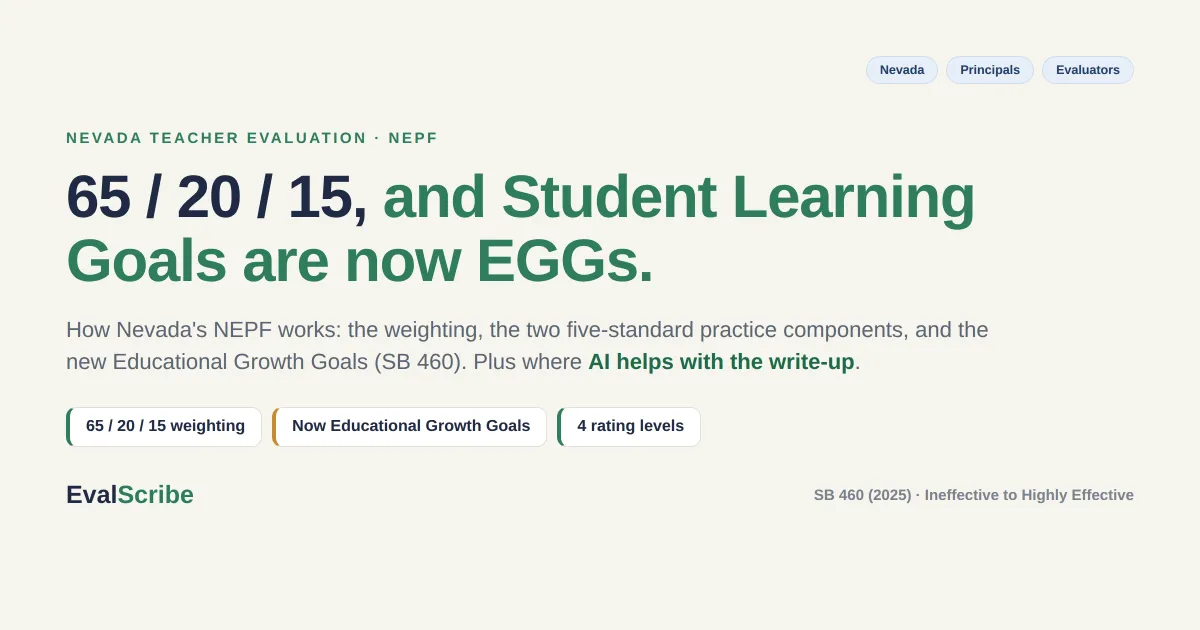
The weighting: 65 / 20 / 15
For most teachers, the summative combines the three domains this way:
Instructional Practice — 65%. The observed work of teaching, scored against five standards.
Professional Responsibilities — 20%. The work of teaching beyond the observed lesson, scored against five standards.
Student Performance — 15%. A goal-based measure, described below.
There are important exceptions. First-year probationary teachers and educators at designated turnaround schools do not include student performance data; for them, Instructional Practice weights 80% and Professional Responsibilities 20%. So for a large share of evaluations, the practice domains are the whole score.
Instructional Practice: five standards
The Instructional Practice domain is built on five research-based, high-leverage standards:
New learning is connected to prior learning and experience.
Learning tasks have high cognitive demand for diverse learners.
Students engage in meaning-making through discourse and other strategies.
Students engage in metacognitive activity to increase understanding of and responsibility for their own learning.
Assessment is integrated into instruction.
Each standard has three indicators, and each is rated across four levels. This is the heart of what an evaluator observes and documents.
Professional Responsibilities: five standards
The Professional Responsibilities domain covers the work beyond the observed lesson, also across five standards:
Commitment to the school community.
Reflection on professional growth and practice.
Professional obligations.
Family engagement.
Student perception.
Like the instructional standards, each has three indicators. Together the two domains give ten standards that a NEPF evaluation documents.
Student Performance: now Educational Growth Goals
The third domain changed in 2025. Under SB 460, Student Learning Goals (SLGs) became Educational Growth Goals (EGGs), scored on a five-point scale and still weighting 15% of the summative. The educator sets the goal and gathers evidence over the cycle, and the evaluator scores it using the goal rubric in the district's NEPF process. SB 460 also updated probationary observation cycles, restructured Performance Improvement Plans with defined timelines and coaching, established a statewide evaluator certification program, and requires an annual review of at least 3% of evaluations. The terminology matters: a tool that still says "Student Learning Goals" is a step behind the current framework.
The four rating levels
The NEPF produces one of four final ratings, with cut scores approved for 2021-22 and beyond: Highly Effective (3.60–4.0), Effective (2.80–3.59), Developing (1.91–2.79), and Ineffective (1.0–1.9). Teachers rated Developing or Ineffective typically receive additional support through a Performance Improvement Plan.
After the observation: where the work piles up
The observation itself is familiar work for an experienced Nevada evaluator. The write-up that follows is where the hours go: taking fragmentary observation notes and organizing them as evidence against the right standard and indicator, settling on a defensible level for each, and drafting feedback a teacher can act on — across a full caseload, and in a way that holds up.
Where AI helps with the NEPF write-up
The strongest fit between current AI and Nevada's system is that practice-domain documentation.
AI handles three parts of it reliably. First, it turns fragmentary notes into coherent, evidence-anchored prose in the framework's language — the difference between "kids explained their thinking to each other" and a sentence tied to the meaning-making standard. Second, it maps evidence to the right standard and indicator, including evidence that supports more than one. Third, it holds consistency across a caseload, so the same quality of evidence lands in similar territory from teacher to teacher rather than drifting with the hour of the night.
For Nevada specifically, the value is drafting in the NEPF's own standard-and-indicator language and toward the four rating levels, so the write-up is defensible from the first draft.
Where AI doesn't help — and what stays with the evaluator
The honest scope follows from how the NEPF is built.
AI cannot score the Student Performance domain. Educational Growth Goals are set, evidenced, and scored in the district's process; that 15% is not an observation the app drafts.
AI cannot calculate the summative rating. Combining the domains at their weights and applying the cut scores to land on Highly Effective, Effective, Developing, or Ineffective is the district's NEPF process.
AI cannot supply an evaluator's professional judgment — what the evidence really shows, how a lesson fit a longer arc, how a rating fits the teacher's year. That stays with the evaluator, who remains the last set of eyes on every rating and comment.
And general-purpose AI in particular has no built-in understanding of the NEPF. Paste notes into a consumer chatbot and it will invent standards, reach for retired terms like Student Learning Goals, and guess at rating levels. For a statewide framework with defined cut scores, those errors surface at the worst possible moment.
What to look for in an AI tool for Nevada
A few questions worth asking before committing a tool to this work.
Does the tool actually know the ten NEPF standards and their indicators, or does it produce generic "good teaching" language?
Is it current with the framework — including the 2025 shift to Educational Growth Goals?
Does it draft toward Nevada's four levels and cut scores rather than a generic good-to-bad scale?
Does it stay in its lane, drafting the two practice domains and leaving Student Performance and the summative calculation to your district?
Where does your observation data live? Is it stored on the vendor's servers, or used to train models?
How EvalScribe handles the NEPF
EvalScribe is built around all ten NEPF practice standards — five Instructional Practice and five Professional Responsibilities — with the framework's own indicators. An evaluator captures notes by typing, dictating, or photographing handwriting (Smart Scan OCR converts it to text), EvalScribe maps that evidence to the standard and indicator it supports, and drafts a rating and evidence-anchored feedback for each — using the NEPF's language across the four levels. Every rating and comment is fully editable before you finalize it, and the evidence stays traceable to the note it came from.
Two scope notes, because the NEPF calls for them. First, EvalScribe drafts the two practice domains — Instructional Practice (65%) and Professional Responsibilities (20%), the 85% that comes from observation and evidence. The Student Performance domain (15%, via Educational Growth Goals) and the final cut-score calculation are handled in your district's NEPF process, not the app. Second, EvalScribe uses the framework as it stands now, including the 2025 shift from Student Learning Goals to Educational Growth Goals.
Beta testers report saving 30 to 60 minutes per evaluation versus writing the documentation by hand. Across a full caseload, that adds up to dozens of hours back — hours that can go to the coaching conversation the NEPF is built to support. More detail on the Nevada workflow is available at evalscribe.com/nevada.
Frequently asked questions about the NEPF and AI
Does EvalScribe support the NEPF? Yes — all ten practice standards across Instructional Practice and Professional Responsibilities, with the framework's indicators and four rating levels.
How is a Nevada teacher's rating weighted? Instructional Practice 65%, Professional Responsibilities 20%, Student Performance 15% — with first-year probationary and turnaround teachers weighting practice at 100%.
What changed with SB 460? Student Learning Goals became Educational Growth Goals (five-point scale, still 15%), plus new PIP structure, evaluator certification, and an annual review requirement.
Does EvalScribe calculate the summative rating? No. It drafts the two practice domains; Student Performance and the cut-score calculation stay in your district's process.
What are the NEPF rating levels? Highly Effective (3.60–4.0), Effective (2.80–3.59), Developing (1.91–2.79), Ineffective (1.0–1.9).
If you're evaluating teachers in Nevada, see how EvalScribe drafts across the NEPF standards at evalscribe.com/nevada. Questions, or a school or district license? Reach the team at [email protected].
References
Nevada Department of Education, Nevada Educator Performance Framework (NEPF) (three domains; SB 460 shift to Educational Growth Goals; 15% weighting)
Nevada Administrative Code, NAC 391.576 — Professional Responsibilities (the five Professional Responsibilities standards and indicators)
Clark County School District Board, NEPF Reference 3.01(A) (the five Instructional Practice standards; 65/20/15 weighting; cut scores and rating levels)
Related articles
Page maintained by Anthony D. Neely, Ph.D. — practicing K-12 educator with nearly 20 years in the classroom, 2025–2026 Walker County Distinguished Teacher of the Year, and co-founder of EvalScribe. Framework details verified against the Nevada Department of Education's NEPF resources, Nevada Administrative Code Chapter 391, and district NEPF references.
Last updated on August 2, 2026.