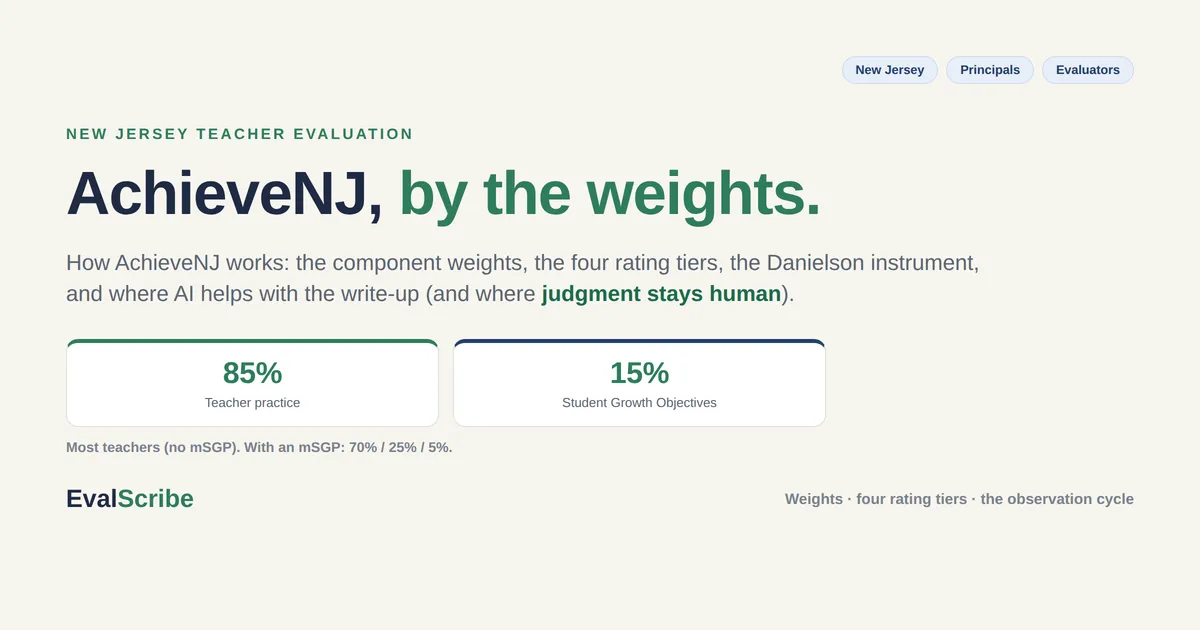
New Jersey evaluates teachers through AchieveNJ: teacher practice (85% or 70%) on a state-approved instrument like Danielson, plus SGOs and mSGP. Where AI helps with the observation write-up, where it doesn't.

How can AI help New Jersey evaluators write AchieveNJ teacher evaluations?

August 02, 20268 min read

How can AI help New Jersey evaluators write AchieveNJ teacher evaluations?

New Jersey evaluates teachers through AchieveNJ: teacher practice (85% or 70%) on a state-approved instrument like Danielson, plus SGOs and mSGP. Where AI helps with the observation write-up, where it doesn't.

New Jersey runs teacher evaluation through a statewide system called AchieveNJ, and it's built on multiple measures: teacher practice plus student growth. The teacher-practice piece — scored on a state-approved instrument through classroom observations — is the largest component, and it's where AI can genuinely help. It can draft the observation write-up, mapping evidence to the right part of the framework and putting it in the framework's own language. What it can't do is measure student growth, apply the weights, or replace an evaluator's judgment. This post walks through where AI helps with AchieveNJ, where it doesn't, and what to look for.

What AchieveNJ actually is

AchieveNJ is New Jersey's educator evaluation system, established under the TEACHNJ Act of 2012 and set out in regulation at N.J.A.C. 6A:10. It's administered by the New Jersey Department of Education, and it applies statewide: every teacher receives an annual summative rating of Highly Effective, Effective, Partially Effective, or Ineffective.

The rating combines two kinds of measures. Teacher practice is scored on a practice instrument, primarily through observations. Student growth is measured through Student Growth Objectives and, for some teachers, a median Student Growth Percentile. The state sets how these components are weighted, and posts the weights each year.

How the components are weighted

For the 2025-2026 school year, the weights are:

Non-mSGP teachers — those in non-tested grades and subjects: Teacher Practice 85%, SGO 15%.

mSGP teachers — those who qualify for a median Student Growth Percentile: Teacher Practice 70%, SGO 25%, mSGP 5%.

Most teachers fall into the first group, so for a large majority, teacher practice is 85% of the rating — the single largest thing an evaluator documents. The NJDOE has adjusted these weights over the years, so it's worth confirming the current figures each fall; a tool that hard-codes an old split will mislead.

Who qualifies for an mSGP

The median Student Growth Percentile applies only to a specific group: English language arts teachers in grades 4-8 or mathematics teachers in grades 4-7, with at least 20 qualifying students, who are the teacher of record for at least 60% of the course before the state assessment. For everyone else, there's no mSGP, and the rating rests on practice and SGOs alone.

The practice instrument: usually Danielson

AchieveNJ doesn't mandate a single practice instrument. Instead, districts choose from a list of state-approved instruments — Danielson, Marzano, Stronge, McREL, and others. The most widely adopted is the Charlotte Danielson Framework for Teaching, which organizes the observed work of teaching into four domains:

Planning and Preparation. Knowledge of content, students, and resources, and coherent instructional design and assessment planning.

Classroom Environment. A culture of respect and rapport, clear expectations, managed routines, and a space that supports learning.

Instruction. Clear communication, strong questioning and discussion, engaging students in the work of learning, and using assessment to adjust in the moment.

Professional Responsibilities. Reflection on practice, accurate record-keeping, communication with families, professional growth, and contribution to the school community.

Practice-instrument scores map onto the same four summative levels the state uses.

The observation schedule

AchieveNJ sets minimum observations: three per year for non-tenured teachers and two for tenured teachers, each at least 20 minutes. Within those, every teacher must have at least one announced and one unannounced observation, and a post-conference follows each one. Teachers who end the year Partially Effective or Ineffective receive an additional observation the next year under a corrective action plan.

That cadence means a fair amount of writing across a caseload, and the post-conference depends on having the write-up ready.

After the observation: where the work piles up

The observation itself is familiar work for an experienced New Jersey evaluator. The write-up that follows is where the hours go: taking fragmentary observation notes and organizing them as evidence against the right domain and component, settling on a defensible level for each, and drafting feedback a teacher can act on — in time for the required post-conference, and across every observation the schedule demands.

Where AI helps with the AchieveNJ write-up

The strongest fit between current AI and New Jersey's system is that teacher-practice documentation.

AI handles three parts of it reliably. First, it turns fragmentary notes into coherent, evidence-anchored prose in the framework's language — the difference between "kids explained their reasoning to each other" and a sentence tied to the instruction domain. Second, it maps evidence to the right component, including evidence that supports more than one. Third, it holds consistency across a caseload, so the same quality of evidence lands in similar territory from teacher to teacher rather than drifting with the hour of the night.

For New Jersey specifically, the value is drafting in the Danielson framework's own language and toward the four rating levels, so the write-up is ready for the post-conference rather than something you assemble afterward.

Where AI doesn't help — and what stays with the evaluator

The honest scope follows from how AchieveNJ is built.

AI cannot measure student growth. Tools like EvalScribe draft the teacher-practice component. The Student Growth Objectives, the median Student Growth Percentile, and the weighted combination into a summative rating are handled in your district's AchieveNJ process.

AI cannot supply an evaluator's professional judgment — what the evidence really shows, how a lesson fit a longer arc, how a rating fits the teacher's year. That stays with the evaluator, who remains the last set of eyes on every rating and comment, and who leads the post-conference.

And general-purpose AI in particular has no built-in understanding of AchieveNJ. Paste notes into a consumer chatbot and it will invent components, assume the observation is the whole rating, and guess at rating levels. For a statewide system with defined weights and a required post-conference, those errors surface at the worst possible moment.

What to look for in an AI tool for New Jersey

A few questions worth asking before committing a tool to this work.

Does the tool actually know the Danielson domains and components, or does it produce generic "good teaching" language?

Does it draft toward New Jersey's four levels and your district's rubric rather than a generic good-to-bad scale?

Does it stay in its lane, drafting teacher practice and leaving SGOs, mSGP, and the summative calculation to your district?

Does it produce a clean written record ready for the required post-conference?

Where does your observation data live? Is it stored on the vendor's servers, or used to train models?

How EvalScribe handles New Jersey evaluations

EvalScribe is built around the four Danielson domains, the practice instrument most New Jersey districts use. An evaluator captures notes by typing, dictating, or photographing handwriting (Smart Scan OCR converts it to text), EvalScribe maps that evidence to the component it supports, and drafts a rating and evidence-anchored feedback for each — using the framework's own language and drafting toward New Jersey's four levels. Every rating and comment is fully editable before you finalize it, and the evidence stays traceable to the note it came from, which is exactly what the post-conference needs.

Two scope notes, because AchieveNJ calls for them. First, EvalScribe drafts the teacher-practice component — the observation-based piece, 85% of the summative for most teachers and 70% for those with an mSGP. The Student Growth Objectives, the median Student Growth Percentile, and the final summative calculation are handled in your district's AchieveNJ process, not the app. Second, AchieveNJ lets districts choose their practice instrument; EvalScribe is built around Danielson, the most widely adopted, so it fits Danielson districts most directly.

Beta testers report saving 30 to 60 minutes per evaluation versus writing the documentation by hand. Across the observation schedule AchieveNJ requires, that adds up to dozens of hours back — hours that can go to the post-conference conversation the system is built around. More detail on the New Jersey workflow is available at evalscribe.com/newjersey.

Frequently asked questions about AchieveNJ and AI

Does EvalScribe support AchieveNJ? Yes, for the teacher-practice component — built around the Danielson Framework, the most widely used practice instrument, with New Jersey's four rating levels.

How is a New Jersey teacher's rating weighted? Most teachers: Teacher Practice 85%, SGO 15%. mSGP teachers: Teacher Practice 70%, SGO 25%, mSGP 5%.

How many observations does AchieveNJ require? Three per year for non-tenured teachers and two for tenured, each at least 20 minutes, with at least one announced and one unannounced.

What if my district uses Marzano? EvalScribe is built around Danielson, the most widely adopted. Email [email protected] about another approved instrument.

Does EvalScribe calculate the summative rating? No. It drafts teacher practice; SGOs, mSGP, and the weighted rating stay in your district's process.

If you're evaluating teachers in New Jersey, see how EvalScribe drafts in the Danielson domains for AchieveNJ at evalscribe.com/newjersey. Questions, or a school or district license? Reach the team at [email protected].

References

Related articles


Page maintained by Anthony D. Neely, Ph.D. — practicing K-12 educator with nearly 20 years in the classroom, 2025–2026 Walker County Distinguished Teacher of the Year, and co-founder of EvalScribe. Framework details verified against the New Jersey Department of Education's AchieveNJ resources, the 2025-2026 rubric-weight notification, and N.J.A.C. 6A:10.

Last updated on August 2, 2026.

Anthony D. Neely, Ph.D.

Anthony D. Neely, Ph.D.

Anthony Neely is the Founder of EvalScribe, a veteran educator, an AI integration consultant for teaching & learning, researcher, & author.

Back to Blog