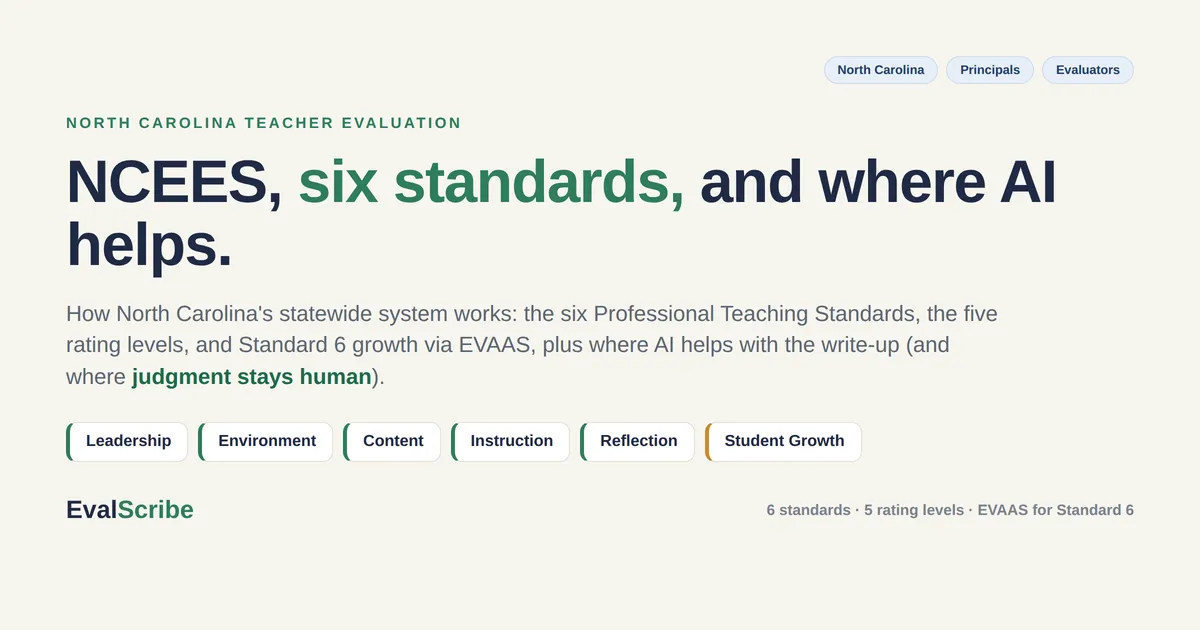
North Carolina evaluates every teacher on NCEES: five NC Professional Teaching Standards scored Not Demonstrated to Distinguished, plus EVAAS student growth. Where AI helps with the observation write-up, where it doesn't.

How can AI help North Carolina evaluators write NCEES teacher evaluations?

August 06, 20268 min read

How can AI help North Carolina evaluators write NCEES teacher evaluations?

North Carolina evaluates every teacher on NCEES: five NC Professional Teaching Standards scored Not Demonstrated to Distinguished, plus EVAAS student growth. Where AI helps with the observation write-up, where it doesn't.

North Carolina evaluates every teacher on the same statewide system, the North Carolina Educator Evaluation System, built on five Professional Teaching Standards. The bulk of what an evaluator documents is those five standards, scored from classroom observation on a five-level scale. That's where AI can genuinely help — drafting the observation write-up, mapping evidence to the right standard and element, and putting it in the rubric's own language. What it can't do is calculate the EVAAS student-growth measure or replace an evaluator's judgment. This post walks through where AI helps with NCEES, where it doesn't, and what to look for.

What NCEES actually is

The North Carolina Educator Evaluation System (NCEES), sometimes called the Educator Effectiveness System, is the evaluation system for all educators in the state. It is administered by the North Carolina Department of Public Instruction and runs in an online environment. Teacher practice is scored on the Rubric for Evaluating North Carolina Teachers, which is organized around the state's five Professional Teaching Standards.

Because the standards and the rubric are set at the state level, a teacher in Charlotte and a teacher in a rural district are held to the same framework. The goal, stated plainly by the state, is for every educator to be rated proficient or higher.

The five Professional Teaching Standards

Each standard is described across several elements and rated on the same scale. The five are:

Standard 1 — Teachers demonstrate leadership. Leadership in the classroom, the school, and the profession, advocating for students, and upholding professional ethics.

Standard 2 — Teachers establish a respectful environment for a diverse population of students. High expectations, responsiveness to individual and cultural differences, and work with families and communities.

Standard 3 — Teachers know the content they teach. Alignment with standards, deep content knowledge, and making content relevant and connected across disciplines.

Standard 4 — Teachers facilitate learning for their students. Planning for diverse learners, varied instructional methods, developing critical thinking, and assessing and communicating progress.

Standard 5 — Teachers reflect on their practice. Analyzing student learning, linking professional growth to goals, and adapting in a complex, changing environment.

The five rating levels

North Carolina rates each standard on a five-level scale: Not Demonstrated, Developing, Proficient, Accomplished, Distinguished. Proficient is the expected standard — beginning teachers must reach Proficient on Standards 1-5 to advance their license. A rating of Not Demonstrated requires a written comment, and a pattern of Not Demonstrated or Developing ratings can trigger a Directed Growth Plan. The distinctions between adjacent levels are specific, which is exactly what makes the write-up demanding.

The observation schedule

NCEES sets the observation requirements in state rule. Probationary teachers receive three formal observations by the principal and one by a peer. Career-status teachers, in a year they are formally evaluated, receive three observations, at least one of them formal. A formal observation lasts at least 45 minutes or a full class period, and the first formal observation is preceded by a pre-observation conference in which the teacher shares a self-assessment and a description of the lesson.

That is a substantial amount of observation, and each one needs a written record tied back to the standards.

Student growth: the EVAAS measure

Alongside the observation-based standards, North Carolina measures a teacher's contribution to student growth — often called Standard 6 — through EVAAS, the Education Value-Added Assessment System. EVAAS is the state-adopted value-added model, based on quantitative assessments such as the End-of-Grade and End-of-Course tests. It is calculated by the state, not by the evaluator, and it sits apart from the observation write-up.

After the observation: where the work piles up

The observation itself is familiar work for an experienced North Carolina evaluator. The write-up that follows is where the hours go: taking fragmentary observation notes and organizing them as evidence against the right standard and element, settling on a defensible level for each, and drafting feedback a teacher can act on — across every observation the schedule requires, and in time to inform the Teacher Summary Rating Form.

Where AI helps with the NCEES write-up

The strongest fit between current AI and North Carolina's system is that standards-based documentation.

AI handles three parts of it reliably. First, it turns fragmentary notes into coherent, evidence-anchored prose in the rubric's language — the difference between "kids explained their thinking to each other" and a sentence tied to a Standard 4 element. Second, it maps evidence to the right standard and element, including evidence that supports more than one. Third, it holds consistency across a caseload, so the same quality of evidence lands in similar territory from teacher to teacher rather than drifting with the hour of the night.

For North Carolina specifically, the value is drafting in the standards' own language and toward the five rating levels, so the write-up is ready for the summary rating rather than something you have to translate first.

Where AI doesn't help — and what stays with the evaluator

The honest scope follows from how NCEES is built.

AI cannot calculate the EVAAS measure. Standard 6 is a state-calculated value-added score, not an observation the app drafts.

AI cannot supply an evaluator's professional judgment — what the evidence really shows, how a lesson fit a longer arc, how a rating fits the teacher's year. That stays with the evaluator, who remains the last set of eyes on every rating and comment.

And general-purpose AI in particular has no built-in understanding of the NC standards. Paste notes into a consumer chatbot and it will invent standards and elements, hand out Distinguished freely, and miss that Not Demonstrated requires a comment. For a statewide system tied to licensure and to a Directed Growth Plan, those errors surface at the worst possible moment.

What to look for in an AI tool for North Carolina

A few questions worth asking before committing a tool to this work.

Does the tool actually know the five NC standards and their elements, or does it produce generic "good teaching" language?

Does it draft toward North Carolina's five levels — and hold Proficient as the expected standard rather than inflating to Distinguished?

Does it stay in its lane, drafting Standards 1-5 and leaving the EVAAS measure and the summary rating to the state and district?

Does it flag where a Not Demonstrated rating requires a written comment?

Where does your observation data live? Is it stored on the vendor's servers, or used to train models?

How EvalScribe handles North Carolina evaluations

EvalScribe is built around all five NC Professional Teaching Standards and the Rubric for Evaluating North Carolina Teachers. An evaluator captures notes by typing, dictating, or photographing handwriting (Smart Scan OCR converts it to text), EvalScribe maps that evidence to the standard and element it supports, and drafts a rating and evidence-anchored feedback for each — using the rubric's own language across the five levels. Every rating and comment is fully editable before you finalize it, and the evidence stays traceable to the note it came from, ready to inform the Teacher Summary Rating Form.

Two scope notes, because NCEES calls for them. First, EvalScribe drafts the observation-based Standards 1-5. Standard 6 — the EVAAS student-growth measure — is calculated by the state, and the final Teacher Summary Rating Form and the summative process are handled in your district's NCEES tools, not the app. Second, EvalScribe uses the NC standards and rubric as they stand under the state's current evaluation rules.

Beta testers report saving 30 to 60 minutes per evaluation versus writing the documentation by hand. Across the observation schedule NCEES requires, that adds up to dozens of hours back — hours that can go to the coaching conversation the standards are built to support. More detail on the North Carolina workflow is available at evalscribe.com/northcarolina.

Frequently asked questions about NCEES and AI

Does EvalScribe support NCEES? Yes, for the observation-based component — all five NC Professional Teaching Standards and their elements, with the five rating levels.

How many observations does North Carolina require? Probationary teachers: three formal by the principal and one by a peer. Career-status teachers in a summative year: three, at least one formal.

How is student growth handled? Through EVAAS, the state's value-added model based on End-of-Grade and End-of-Course tests — calculated by the state, separate from Standards 1-5.

What are the rating levels? Not Demonstrated, Developing, Proficient, Accomplished, Distinguished. Proficient is the expected standard.

Does EvalScribe complete the summary rating? No. It drafts the Standards 1-5 write-up; the EVAAS measure and the final summary rating stay in your district's NCEES tools.

If you're evaluating teachers in North Carolina, see how EvalScribe drafts across the NC standards at evalscribe.com/northcarolina. Questions, or a school or district license? Reach the team at [email protected].

References

Related articles


Page maintained by Anthony D. Neely, Ph.D. — practicing K-12 educator with nearly 20 years in the classroom, 2025–2026 Walker County Distinguished Teacher of the Year, and co-founder of EvalScribe. Framework details verified against the North Carolina Department of Public Instruction's NCEES resources and 16 NCAC 06C .0503.

Last updated on August 6, 2026.

Anthony D. Neely, Ph.D.

Anthony D. Neely, Ph.D.

Anthony Neely is the Founder of EvalScribe, a veteran educator, an AI integration consultant for teaching & learning, researcher, & author.

Back to Blog