How long it takes to write a teacher evaluation — a school administrator's desk late at night under a warm lamp, with handwritten observation notes and a laptop, illustrating the after-hours write-up that consumes most of a principal's evaluation time.

How long does it take to write a teacher evaluation?

August 08, 20266 min read

How long does it take to write a teacher evaluation?

How long it takes to write a teacher evaluation — a school administrator's desk late at night under a warm lamp, with handwritten observation notes and a laptop, illustrating the after-hours write-up that consumes most of a principal's evaluation time.

August 8, 2026• ~6 min read

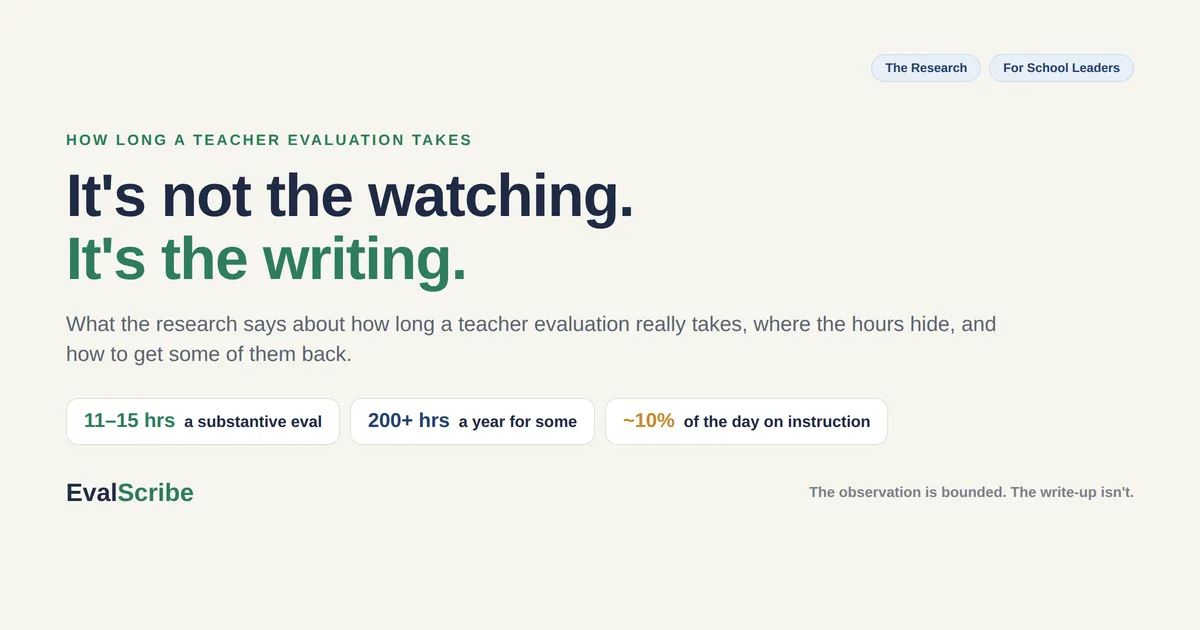
Short answer: Longer than almost anyone budgets for. Individual write-ups commonly run one to three hours per teacher, and across a full caseload the totals are startling: a 2013 national survey of principals put a substantive evaluation at 11 to 15 hours of a principal's time, and some school leaders report spending 200-plus hours a year on evaluation. The observation itself is a small slice of that; the hours live in the write-up — translating notes into formal, rubric-aligned prose. Understanding where the time actually goes is the first step to getting some of it back.

What the data actually says

Ask ten administrators how long a teacher evaluation takes and you'll get ten shrugs, because most have never measured it. The research that has measured it is sobering.

Education Week's reporting on how evaluation reshaped the principalship put concrete numbers on the burden: one principal estimated three hours to complete a single teacher's evaluation, and a 2013 National Association of Elementary School Principals survey found that completing a substantive evaluation consumes 11 to 15 hours of a principal's time. In the same reporting, one Michigan principal estimated he spent 270 hours on evaluation in a single school year — reviewing, as he put it, everyone but the custodian — and described putting in six- and seven-hour Sundays to keep up. That is not an outlier of disorganization. It's what the job now asks.

It compounds against an already-full week. A widely cited study of how principals use their time found principals spend only a little over ten percent of their day on instruction-related work of any kind — and within that thin slice, preparing and conducting observations already eats the majority of it. Meanwhile surveys have clocked principals at 60-hour weeks. The evaluation paperwork doesn't get added to a light schedule. It gets wedged into evenings and Sundays.

The observation is not the time sink — the write-up is

Here's the distinction that reframes the whole question. When leaders describe evaluation as exhausting, they are almost never describing the time spent watching instruction. A 45-minute observation is 45 minutes. The hours come after — turning a page of walkthrough notes into a formal, standards-aligned, defensible written evaluation, for every teacher, several times a year.

That's the translation tax: the gap between the honest evidence a leader gathered in the room and the polished, rubric-language document the system requires. A single strong observation might take under an hour to conduct and two or three hours to write up well. Multiply the write-up by a full roster and a multi-observation cycle, and you arrive at the 100- and 200-hour annual totals the reporting describes — almost all of it in the writing, not the watching.

What those hours actually cost

The obvious cost is the evenings. The less obvious one is more expensive.

Every hour a leader spends converting notes into prose is an hour not spent in classrooms, coaching, or leading instruction — the work that actually moves teaching. The time-use research makes the tradeoff concrete: administration and paperwork dominate the principal's day, while instructional leadership gets the leftovers. When the write-up burden grows, it doesn't come out of nowhere; it comes out of the instructional-leadership time that was already scarce. A tired leader writing a fourth evaluation at 11 p.m. also writes a thinner one — less specific, less useful to the teacher, less defensible later. The paperwork doesn't just take time. Past a point, it degrades the very feedback it exists to produce.

Where the time hides — and how to get some back

If you want to shrink the number, you first have to see it. Three moves help.

Audit your actual write-up time. Not the estimate — the real figure. Time yourself on the next three evaluations, from blank page to finished document, and multiply by your roster and your observation cycle. Most leaders are genuinely surprised by the total, and you can't manage what you haven't measured.

Separate evidence capture from composition. Much of the write-up slowness is re-deriving what you saw. Low-inference notes taken against your framework's language during the observation — evidence, not impressions — turn the write-up from "compose from scratch" into "assemble and refine." The clearer the evidence going in, the faster the prose comes out.

Draft against the framework, then edit — don't compose from blank. The single biggest time sink is staring at an empty page trying to render observed evidence into rubric language. Starting from a draft you edit, rather than a blank you author, is where the largest time savings live. That is exactly the seam where thoughtful AI use earns its place: not observing, not judging, not scoring — but taking the evidence you already gathered and drafting it against the framework, so you edit instead of compose.

How EvalScribe fits

This is the specific burden EvalScribe was built for. It takes the observation evidence a leader already gathered and drafts a formal, standards-aligned evaluation from it — so the hours disappear from the write-up rather than from the time spent watching teaching. It doesn't observe, and it doesn't decide the rating; the leader makes every call and edits the draft. Beta testers report saving 30 to 60 minutes per evaluation that way. Across a common caseload — say 40 teachers and three observations each — that is roughly 60 hours back over a year, most of it reclaimed from evenings and Sundays. If you want to run your own numbers, the district capacity calculator does the arithmetic: your minutes per write-up, times your teachers, times your observation cycles. Adoption is simple — no long training, no consultant — though the work of evaluating well never is.

Frequently asked questions

How long does it take to write one teacher evaluation? Commonly one to three hours per teacher for a substantive write-up, depending on the framework and how the evidence was captured. Education Week reported one principal's estimate of three hours per evaluation, and a 2013 NAESP survey put a substantive evaluation at 11 to 15 hours of a principal's time.

How many hours a year do principals spend on evaluations? It varies widely by roster size and observation cycle, but the reporting describes leaders spending anywhere from dozens to 200-plus hours a year, much of it outside regular hours.

Is the observation or the write-up the bigger time cost? The write-up, by a wide margin. The observation is bounded; the translation of notes into formal, rubric-aligned prose, repeated across a roster, is where the hours accumulate.

How can I reduce the time without cutting corners? Measure your real write-up time, capture low-inference evidence against your rubric during the observation, and draft-then-edit rather than composing from a blank page — including, when it fits, AI that drafts from your evidence while you keep the judgment.

The observation was never the part that ate the week. The question worth asking is why the write-up ever had to.


About the author

Anthony Neely is the Founder of EvalScribe, a veteran educator, an AI integration consultant for teaching & learning, researcher, & author.


Related articles

Anthony D. Neely, Ph.D.

Anthony D. Neely, Ph.D.

Anthony Neely is the Founder of EvalScribe, a veteran educator, an AI integration consultant for teaching & learning, researcher, & author.

Back to Blog