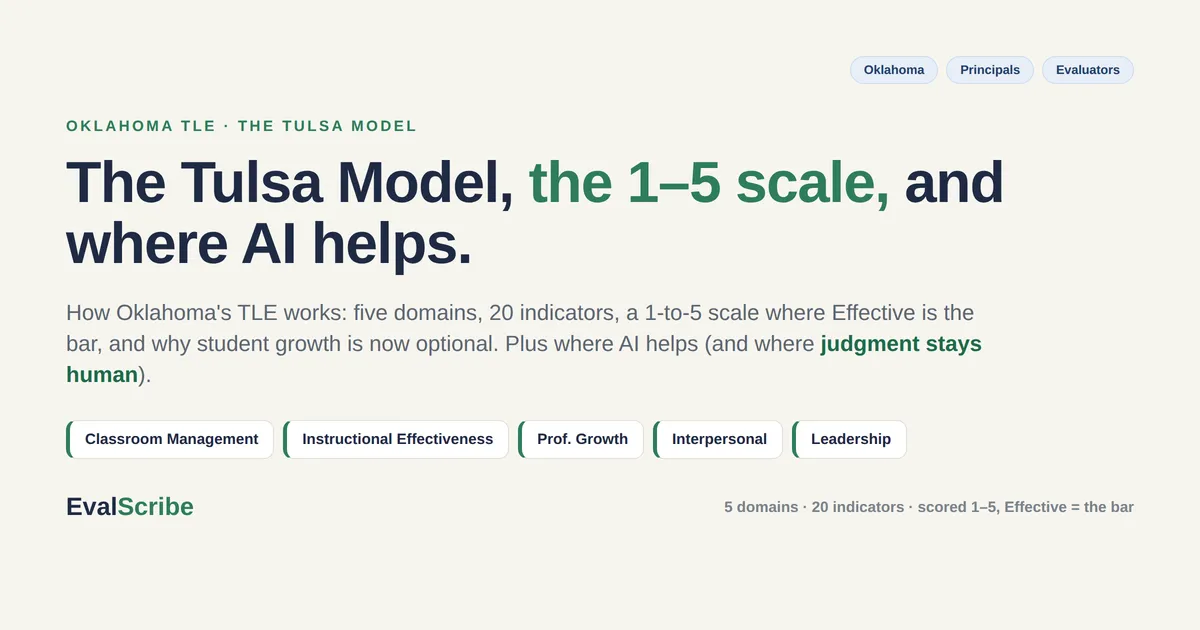
What is the Tulsa Model, and how does Oklahoma's TLE score teachers?
August 1, 2026 • ~7 min read

Short answer: The Tulsa Model is one of Oklahoma's state-approved teacher-observation frameworks under the Teacher and Leader Effectiveness (TLE) system. It organizes teaching into five domains — Classroom Management, Instructional Effectiveness, Professional Growth and Continuous Improvement, Interpersonal Skills, and Leadership — spread across 20 indicators, and scores each on a five-point scale: Superior (5), Highly Effective (4), Effective (3), Needs Improvement (2), and Ineffective (1). Career teachers are observed twice a year and probationary teachers more often. Two things make it distinct from the four-level frameworks used elsewhere, and both matter at scoring time.
What the Tulsa Model and TLE actually are
TLE — Teacher and Leader Effectiveness — is Oklahoma's statewide evaluation system. Rather than mandate a single rubric, the state approves a short list of qualitative frameworks and lets districts adopt one. The Tulsa Model — developed originally by Tulsa Public Schools — is one of those approved teacher frameworks and one of the most widely used across the state.
So the first practical point is one of identity: "we're a TLE district" doesn't tell you which rubric a teacher is scored on. Confirm your district adopted the Tulsa Model specifically before you calibrate, because the domains and the scale below are the Tulsa Model's, not TLE's in general.
The five domains and 20 indicators
The Tulsa Model spreads teaching across five domains and 20 indicators. What stands out is how much lives outside pure instruction:
Classroom Management — the conditions that make learning possible: preparation, discipline, building-wide procedures, the learning environment.
Instructional Effectiveness — the largest domain, and the one a walkthrough spends the most time in: delivery, content knowledge, checks for understanding, and adjustment.
Professional Growth and Continuous Improvement — the teacher's own trajectory: using feedback, reflection, and ongoing development.
Interpersonal Skills — a full domain in its own right: how the teacher builds relationships with students, families, and colleagues.
Leadership — contribution beyond the classroom, to the team and the school.
Compared with frameworks that fold everything into instruction and planning, the Tulsa Model elevates Interpersonal Skills and Leadership to standalone domains. That's a design choice worth noticing: it means a teacher's evaluation formally accounts for the relational and collaborative work that some rubrics only imply.
The five-point rating scale — and why it's a trap for evaluators trained elsewhere
Each indicator is scored on a five-point scale: Superior (5), Highly Effective (4), Effective (3), Needs Improvement (2), Ineffective (1), with "N/A" and "N/O" (not observed) available where an indicator doesn't apply or wasn't seen.
Here's the trap. Evaluators who came up on a four-level framework — where the top band is "Distinguished" or "Highly Effective" and represents genuinely excellent, expected-of-a-strong- teacher practice — tend to import that mental model. On the Tulsa Model's five-point scale, Effective (3) is the standard for solid, expected practice, and Superior (5) is a genuine outlier — sustained, exceptional, not the reward for a good lesson. Score a strong-but-normal lesson a 5 because it "went well," and you've compressed the top of your scale until it means nothing. The extra band exists to distinguish the truly exceptional from the reliably good; using it as a synonym for "no complaints" throws that away.
The observation cycle Oklahoma requires
Under current OSDE guidance, the observation cycle depends on career status:
Career teachers: at least two observations a year — one with actionable feedback in the fall, one with actionable feedback in the spring.
Probationary teachers: an observation in each of the first three nine-week periods, plus a final evaluation in the fourth, with a feedback conference following each.
Every certified educator (except the superintendent) also sets an annual Professional Learning Focus, established by the end of the district's first nine weeks. The through-line across all of it is actionable feedback — the requirement isn't just to observe, it's to turn each observation into something a teacher can use, in writing, soon enough to matter.
What the domains look like in the room
The Tulsa Model is evidence-based: a score has to rest on what you observed, mapped to the indicator language, not on a general impression. In Instructional Effectiveness, a check for understanding is evidence gathered from students — their work, their responses — and used to adjust, not a rhetorical "everybody good?" In Classroom Management, the evidence is in transitions, established procedures, and how little instructional time leaks away. In Interpersonal Skills, it's in the observable interactions — how the teacher responds to a struggling student, how families are communicated with. Your notes should quote what you actually saw against the indicator, so the score is defensible when it's read back.
Common Tulsa Model scoring mistakes
A handful recur. Treating 5 as the reward for a good lesson, which collapses the scale's top two bands. Treating 3 as a disappointment, when Effective is exactly where a solid career teacher should land. Under-scoring the non-instructional domains — rushing Interpersonal Skills and Leadership because a walkthrough naturally centers on instruction, when the model weights them as full domains. And scoring from impression rather than indicator evidence, which is the fastest way to lose a rating in a feedback conference.
Oklahoma in context
Two structural distinctions define the Tulsa Model against the frameworks used in neighboring states. First, the five-point scale — most state rubrics run four levels, so an evaluator or a tool built for a four-level framework has to genuinely recalibrate, not just relabel. Second, the five-domain breadth that makes Interpersonal Skills and Leadership standalone domains rather than sub-points folded into instruction. Add the district-choice design of TLE — where the Tulsa Model is one approved option among several — and "Oklahoma teacher evaluation" is never a single thing. Confirm the framework, the version, and the local implementation before you assume.
What this means for you
If you evaluate teachers in Oklahoma on the Tulsa Model, precision is the whole game: evidence mapped to the right indicator, scored honestly on a five-point scale you haven't inflated, across five domains — not just the instructional one. The burden isn't the observing; two to several observations a year per teacher is the job, and it's where coaching happens. The burden is the turnaround — converting each observation into written, actionable, indicator-aligned feedback for every teacher, twice a year or more. Let that slip and the feedback loses both its coaching value and its defensibility. A reasonable next step is to audit your own turnaround: how many minutes each Tulsa Model write-up actually takes you, times your teachers, times the required observations. Most Oklahoma leaders are surprised by the total.
How EvalScribe fits
EvalScribe supports the Oklahoma Tulsa Model: it takes the observation evidence you already gathered and drafts a Tulsa-Model-aligned write-up against the indicator language, so the fall-and-spring turnaround stops eating your evenings. It doesn't observe, and it doesn't assign the score — you make every call, the five-point judgment stays yours, and you edit and sign. What changes is the time between the observation and the finished, defensible document. To put a number on that turnaround, the district capacity calculator runs the arithmetic for your building. Adoption is simple — no long training, no consultant — but scoring the Tulsa Model well is not, and no tool should pretend otherwise.
Frequently asked questions
What are the five domains of the Tulsa Model? Classroom Management, Instructional Effectiveness, Professional Growth and Continuous Improvement, Interpersonal Skills, and Leadership — 20 indicators in all. See the Tulsa Model overview.
What is the Tulsa Model rating scale? A five-point scale: Superior (5), Highly Effective (4), Effective (3), Needs Improvement (2), and Ineffective (1), plus "N/A" and "N/O" designations. Effective (3) is the expectation for solid practice; Superior (5) is reserved for genuinely exceptional performance.
How many observations does Oklahoma's TLE require? Career teachers: at least two per year (fall and spring, each with actionable feedback). Probationary teachers: an observation in each of the first three nine-week periods plus a final evaluation, per OSDE guidance.
Is the Tulsa Model the only framework Oklahoma uses? No. TLE approves several qualitative frameworks and districts choose one; the Tulsa Model is a widely used approved option. Confirm which framework your district adopted. See the OSDE TLE qualitative components page.
The Tulsa Model gives Oklahoma evaluators a wide-angle, five-point instrument. The question it leaves on every leader's desk is how much of the week the write-up after the observation is allowed to take.
About the author
Anthony Neely is the Founder of EvalScribe, a veteran educator, an AI integration consultant for teaching & learning, researcher, & author.
Related articles
How can AI help Oklahoma evaluators write teacher evaluations under the TLE Tulsa Model? — the direct Oklahoma Tulsa Model companion post
AI for Oklahoma teacher evaluations (Tulsa Model / TLE) — the Oklahoma state landing page
How can AI help Indiana evaluators write RISE teacher evaluations?