What Teachers Actually Want from Post-Observation Feedback

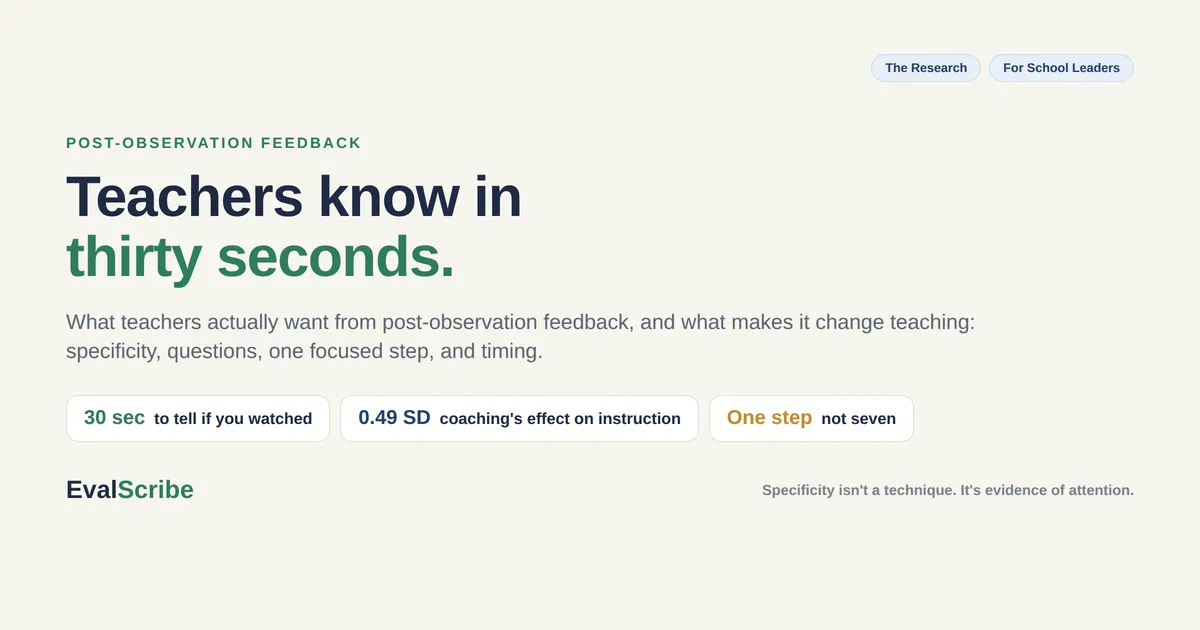
Teachers want post-observation feedback that proves the administrator actually watched the classroom. The single most consequential factor in whether feedback lands isn't the framework, the format, or the technique — it's whether the teacher can tell, in the first thirty seconds of the conversation, that the admin saw something real. Specificity isn't a feedback technique. It's evidence of attention. This post is a teacher's perspective on what makes post-observation conversations work, what makes them fail, and what administrators can do to make sure the feedback they give actually changes the teaching it's supposed to support.
A teacher's perspective
I'm a 7th grade social studies teacher in my eighteenth year in the classroom. I'm also the Professional Learning Lead at my Title I middle school, where I work with administrators on instructional coaching and faculty development. I co-developed the K12 National Social Studies Professional Development series.
I'm not a principal. I don't run post-observation conferences. But I've sat in hundreds of them from the other side of the desk, and in my PL Lead role, I work alongside the administrators who give the feedback. That vantage matters for this post — because most of the writing on post-observation feedback comes from former administrators or coaching consultants, and it misses something only visible from the teacher's side: how the conversation actually lands, why some feedback changes teaching and other feedback evaporates the moment the teacher leaves the office.
The research on this is substantial. Kraft, Blazar, and Hogan's 2018 meta-analysis examined sixty causal studies and found that observation-linked feedback, done well, has meaningful effects on instructional practice and student outcomes. The work of Hattie, Danielson, Brookhart, and others has shaped how the field thinks about specificity, timing, and the conversational shape of feedback that actually works. The literature is clear. What's less clear, in most of the existing genre content, is what "done well" looks like from where the teacher is sitting.
That's the gap this post is trying to close.
The thirty-second test
Every teacher who's been observed runs an unconscious assessment in the first thirty seconds of a post-observation conversation. The question being assessed is simple: did this person actually watch my classroom?
The signal isn't what the administrator says. It's how specific the opening reference is.
"I noticed the way you handled the moment when Marcus couldn't find his pencil" passes the test. So does "I want to ask you about the question you re-asked after the first two students couldn't answer it" or "The transition into the small-group work — what were you thinking when you changed the grouping at the last minute?" These are statements that could only come from someone who was paying attention.
"I really like how you build community" doesn't pass, no matter how warmly delivered. "I appreciated your engagement strategies" doesn't either. Those are statements that could be made about any teacher's classroom, by anyone, at any time. They tell the teacher nothing about whether the admin was actually present in the room they spent fifteen minutes in.
The thirty-second assessment happens before the administrator gets to any of the feedback content. And it shapes everything that follows.
When the test passes, the teacher across the desk is engaged. They lean in. They start surfacing their own questions about the lesson — I wasn't sure about that one moment either, what did you see? — and a real conversation happens. The feedback that follows, even when it's challenging, lands as information rather than as judgment.
When the test fails, the teacher remains polite. They nod. They say thank you. They might even agree with everything the administrator says. And they leave the office and change nothing about their teaching, because the conversation never registered as one worth learning from. The administrator's intentions don't matter at this point. The conditions for learning weren't there.
The thirty-second test isn't something administrators can fake. It can only be passed by an administrator who actually watched the classroom — which means it can only be passed by an administrator who set themselves up to be able to watch during the observation itself. Everything in a post-observation conference is downstream of what happened during the walkthrough.
Why specificity actually matters
The standard advice in this genre is to be specific. Almost every post-observation feedback article repeats it. The advice is correct. But it's usually framed as a technique — something administrators do because being specific is a feedback best practice.
Specificity isn't a technique. It's evidence of attention.
When an administrator references a concrete moment in the lesson, the teacher reads that as proof of presence. The admin was there. They watched. They noticed. The feedback that follows — whether it's affirmation, challenge, or question — carries the weight of having been earned by actual observation.
When the feedback is generic, the teacher reads it as proof that the admin had a clipboard, not that they had attention. "Good lesson structure" can be said about almost any lesson. "Strong engagement strategies" can describe almost any classroom that wasn't actively on fire. These phrases protect the admin from being wrong — they're vague enough that no teacher could push back on them — but the same vagueness that makes them safe also makes them useless.
The corollary nobody states: specificity protects the teacher's expertise as much as it demonstrates the admin's. When an administrator describes what they actually saw, the teacher can respond with what they actually intended. "I noticed you redirected James three different ways before he settled in" lets the teacher say "yes, the first two didn't work because he hadn't slept — I knew that, but I had to try the easier interventions first before sitting down with him." That's a real conversation. Both people are bringing what they know, and the result is shared understanding.
Generic feedback leaves no room for that exchange, because there's nothing concrete to discuss. The teacher can't bring their own context to "good engagement strategies." They can only nod and move on.
This is the second function of specificity that the genre advice usually misses: it doesn't just make feedback land. It makes the conversation possible.
Questions instead of verdicts
The familiar version of this advice is to ask questions instead of telling. The deeper version is about authority.
The administrator who asks "what did you notice about the way that lesson went?" is doing something more substantial than employing a coaching technique. They're acknowledging that the teacher knows things about that classroom they don't know. The teacher's lesson is the product of weeks of unobserved work — relationships built, prior knowledge assessed, scaffolds designed, accommodations adjusted, contexts no walkthrough could capture. The administrator saw fifteen or twenty minutes of it. The teacher has been building toward that lesson since August.
A real question respects that asymmetry. A verdict ignores it.
This isn't about being soft. Administrators can and should bring observations, challenges, and disagreements into the conversation. The frame matters more than the substance. "I'm wondering about the way the small-group time went — can you walk me through your thinking on the groupings?" is structurally different from "the small-group time was disorganized." Both can lead to the same conclusion. The first invites partnership; the second closes it.
The teacher who feels challenged but respected is engaged. The teacher who feels judged is performing.
What's worth noticing about question-based feedback is that it usually produces more useful information for the administrator too. The teacher's response often surfaces context the administrator had no way to know — a student's IEP, a tough morning, a deliberate experiment, a constraint the walkthrough couldn't see. That context changes what's actually true about the lesson, and therefore what's actually useful to coach toward. Verdicts close that information loop. Questions open it.
One thing, not seven
The temptation in a post-observation conference is to address everything noticed. The instinct is generous — I want this teacher to have all the information I can give them. The effect is the opposite of what's intended.
A teacher who leaves with seven things to work on works on none of them. A teacher who leaves with one specific, actionable focus has a real chance of changing something.
This isn't an opinion. It's one of the most consistent findings in the instructional-coaching literature. Identify one precise next step. Agree on it together. Follow up specifically about that one thing in the next conversation. The other observations don't disappear; they wait their turn.
For administrators, this requires a discipline of triage that mirrors what good observation already demands — except now the triage is happening in the feedback, not the observation. Of everything noticed, what's the one thing this teacher can change that would matter most, this week? Not the most important thing in some absolute sense. The most actionable thing, given who this teacher is, what they're already working on, and what's realistic in the next five school days.
The teacher who hears that single, focused next step has been given a gift. They know what to do next. They can actually do it. And when the administrator follows up specifically about that thing in the next walkthrough or check-in, the teacher experiences something rare: a coaching relationship that actually tracks, rather than a series of feedback events that dissolve into each other.
The single-step principle is also the antidote to feedback paralysis on the teacher's side. A teacher faced with a checklist of seven things often defaults to addressing none of them, because every choice about which to start with feels like a tacit decision that the others are unimportant. One focus removes that paralysis entirely. The work to do is the work to do.
Timing matters more than most admins realize
Here's the variable that gets the least attention in genre advice and matters the most in practice: how soon the feedback arrives.
The research is reasonably clear. Feedback delivered while the lesson is still fresh in everyone's memory changes teaching at meaningfully higher rates than feedback delivered weeks later. The Kraft/Blazar/Hogan meta-analysis and subsequent work all point in this direction. So does the lived experience of every teacher who's ever sat through a post-observation conference about a lesson they barely remember.
The teacher who receives feedback the day of, or within a day or two, can still reach back into the lesson. They remember what they were thinking when they made a particular choice. They remember what the student response actually was, what the room felt like, what they were considering changing on the fly. The conversation is grounded in shared, specific memory — both people are in the room together, even though the room is mental at this point.
The teacher who receives feedback two weeks later is being asked to discuss a lesson that's now blurred against ten other lessons. The administrator may remember what they observed; the teacher remembers what they generally do, which isn't the same thing. The conversation becomes abstract by necessity, and abstract conversations rarely change practice.
This is the structural problem in most post-observation pipelines. Administrators observe, then have to produce framework-aligned write-ups, then schedule conferences, and by the time the conversation happens, the lesson is cold for both parties. The bottleneck isn't usually the observation itself or the conference itself. It's the translation step in between — turning raw observation into formal documentation — that delays everything downstream.
That bottleneck used to be unavoidable. It isn't anymore. EvalScribe was built to handle exactly that translation step, which is part of why I built it — the cycle that good coaching depends on requires feedback to arrive while the lesson is fresh, and the documentation tax that admins have traditionally carried makes timely feedback nearly impossible at scale. I'm not pitching the tool here so much as naming the real constraint behind a problem that's been treated as just "the way things are." It doesn't have to be.
Whatever tool an administrator uses — or doesn't use — the principle stands: feedback arriving within forty-eight hours of an observation changes teaching at a meaningfully different rate than feedback arriving weeks later. The cycle of coaching depends on a closed loop. Stretching the loop weakens everything inside it.
What feedback feels like when it works
The post-observation conversations that change teaching are unmistakable, both during and after.
During the conversation, the teacher is leaning in, not leaning back. They're surfacing their own questions about the lesson. They're saying things like "I wasn't sure about that part either — what did you see?" or "I made that choice deliberately, but I'm not sure it worked — can we look at what happened?" The administrator's role shifts from delivering verdicts to thinking alongside the teacher about what happened in a classroom they both, in different ways, care about.
After the conversation, the teacher leaves with one specific thing they want to try. They mention the meeting to a colleague — not as an event endured but as something worth thinking about. Sometimes they keep thinking about it for days. Often the thing they want to try wasn't even in the formal feedback; it was something they realized themselves while talking, surfaced by a question the administrator asked.
Days or weeks later, the change shows up in the next lesson. Not as compliance with feedback, but as the teacher having genuinely thought about something and adjusted. That's what coaching looks like when it works.
The difference between a feedback conversation that works and one that doesn't is rarely about the administrator's intentions. Most administrators want their feedback to land. Most do it in good faith. The difference is whether the conditions for the conversation were right — specificity, mutual respect, focused action, and timing. When those align, teachers change. When they don't, the conference is theater, and everyone involved usually knows it.
The point
The best post-observation feedback feels to teachers like a thoughtful person who watched their classroom and wants to think about it with them. Everything else is detail.
If you haven't read the companion posts in this series, they cover what administrators should be looking for in the first five minutes of a walkthrough and why "what should I write down?" is the wrong question during the observation itself. Together, the three posts make the case that what administrators look at, what they capture, and what they say after are one continuous conversation about whether the teacher feels seen.
That's the whole job, really. The frameworks and the rubrics and the documentation are scaffolding around it. The job underneath is letting good teachers know that their work is being noticed, and helping all teachers find the next thing worth working on.
FAQ
What should a post-observation conference cover? The strongest conferences cover three things: specific observations from the lesson grounded in concrete moments, the teacher's reflection on those moments and the choices behind them, and one focused next step to work on before the next observation. Everything else is optional.
How long should a post-observation conference be? Most effective conferences run twenty to thirty minutes — long enough for real conversation, short enough that both parties can stay focused. Conferences shorter than fifteen minutes rarely allow for genuine dialogue; conferences longer than forty minutes tend to drift into territory that would be better handled in a separate coaching session.
How soon after an observation should feedback happen? As soon as possible. The research consistently shows that feedback delivered within forty-eight hours changes teaching at meaningfully higher rates than feedback delivered weeks later. The lesson stays fresh in both parties' memories, and the conversation can be grounded in shared, specific recall.
What do teachers want most from post-observation feedback? Evidence that the administrator actually watched the classroom. Specific references to concrete moments. Questions that respect the teacher's expertise. One focused thing to work on next. Timing that keeps the lesson fresh. These five conditions, when they align, make feedback that lands.
Should post-observation feedback be positive or critical? The framing of positive vs. critical is less useful than the framing of grounded vs. generic. Affirming feedback that's specific and earned lands. Critical feedback that's specific and earned also lands. Generic praise and generic criticism both fail, regardless of which side of the ledger they're on.
What's the difference between coaching feedback and evaluative feedback? Coaching feedback is meant to support a teacher's growth and typically focuses on one or two areas of development at a time. Evaluative feedback informs a formal rating that goes in a personnel file. Both have their place, but conflating them — trying to coach during an evaluation conference or evaluate during a coaching session — tends to weaken both.
How do administrators give feedback that actually changes teaching? Pass the thirty-second test by opening with specific, grounded references. Ask questions rather than delivering verdicts. Identify one focused next step rather than a list. Get the feedback into the teacher's hands while the lesson is still fresh. Follow up specifically about that one step in the next conversation. The principles are simple. The discipline to apply them consistently is the actual work.