
AI-powered teacher evaluations
for Colorado educators.
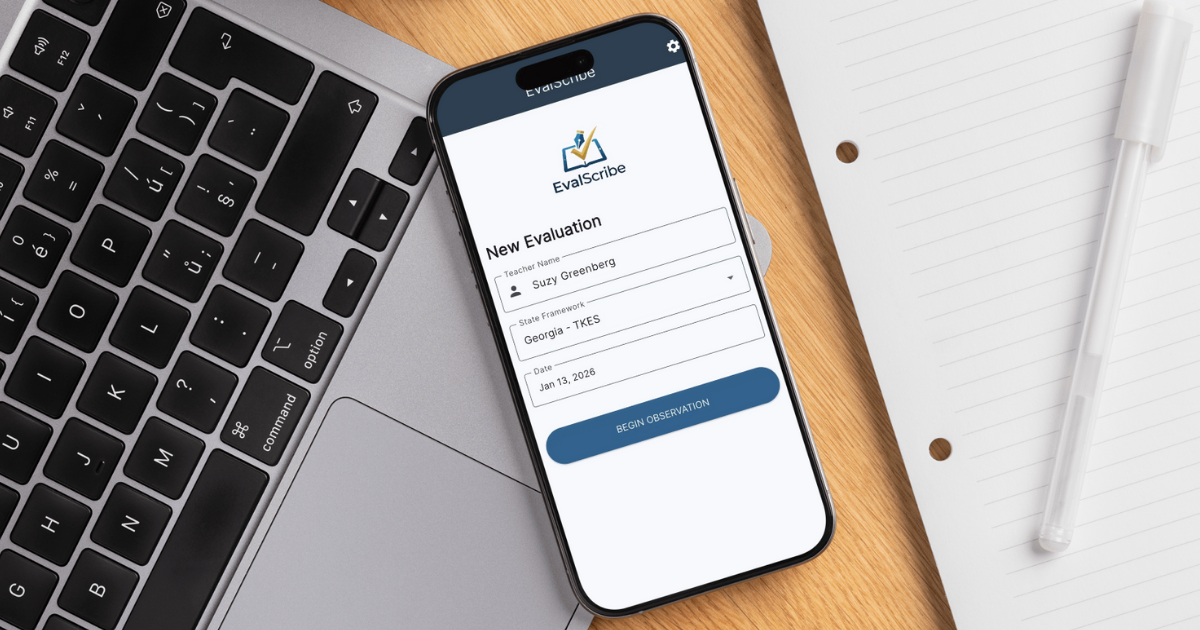
Cut evaluation documentation from hours to minutes. EvalScribe is built around Colorado's State Model Evaluation System natively — the four Teacher Quality Standards and the Highly Effective to Ineffective scale, in the framework's own language.
Saved per evaluation
Teacher Quality Standards, built in
Professional practice share
Evaluator-controlled ratings
Three evaluations free — no credit card · Individual plans from $100/year · School & district licensing available
Endorsed by educational leaders
Game changer. Absolute game changer for school admin.
Tobin Davidson · Assistant Superintendent · 40+ years in education
This is amazing. I would pay lots of money for this. I’m serious — it’s crazy good.
Kittie Brown · Assistant Principal
Also endorsed by Dr. Robert Stinson · Glenn Brown · Angie Brandt — read full quotes ↓
Built by a classroom teacher
Founded by a practicing K–12 educator with nearly 20 years in the field.
Colorado-specific
All four Teacher Quality Standards and the four rating levels, built in natively.
Privacy-first
Transient processing on Microsoft Azure. Never used for AI training.
Built for workflow
Designed around the realities of being a Colorado evaluator.
Colorado's State Model. EvalScribe is built around all four Quality Standards.
Under Senate Bill 10-191, the Great Teachers and Leaders Act, Colorado teachers are evaluated on four Teacher Quality Standards for professional practice plus Measures of Student Learning. The Colorado Department of Education (CDE) publishes a State Model Evaluation System districts may adopt. EvalScribe is built around the four Quality Standards and their rubric language.
Four Teacher Quality Standards
The professional-practice half of Colorado's system is organized into four Quality Standards, each measured through the state's Revised Rubric for Evaluating Colorado Teachers using defined elements. EvalScribe maps your observation evidence to the element it supports and drafts a rating and evidence-anchored feedback in the rubric's own language.
The four Quality Standards.
Content Knowledge
What is taughtTeachers demonstrate mastery of, and pedagogical expertise in, the content they teach, aligned to the Colorado Academic Standards.
Learning Environment
The classroomTeachers establish a safe, inclusive, and respectful learning environment for a diverse population of students.
Facilitation of Learning
InstructionTeachers plan and deliver effective instruction, facilitating learning and using assessment to guide it.
Professionalism
Beyond the lessonTeachers demonstrate professionalism through ethical conduct, reflection, collaboration, and continuous professional growth.
Professional practice and student learning
Colorado combines two portions into a teacher's Final Effectiveness Rating. Beginning in the 2023–24 school year, under SB 22-070, the split emphasizes professional practice: 70% of the rating comes from the four Quality Standards, and the remaining 30% comes from Measures of Student Learning/Outcomes (MSLs/MSOs), which use multiple measures rather than a single assessment. This changed from the earlier 50/50 split.
The four Colorado rating levels.
Highly Effective
Effective
Partially Effective
Ineffective
How EvalScribe handles the Colorado State Model
The four Quality Standards and their elements are built into the tool, each with the state rubric's own language across the four rating levels — Highly Effective, Effective, Partially Effective, and Ineffective — and the distinctions that separate adjacent ratings. EvalScribe maps the evidence from your observation notes to the element it supports and drafts best-fit ratings and evidence-anchored feedback, so the write-up is defensible and traceable back to what you observed.
Scope of the score. EvalScribe drafts the professional-practice piece — the four Quality Standards, which make up 70% of the Final Effectiveness Rating. The Measures of Student Learning/Outcomes (the other 30%) and the combination of both portions into the final rating are handled in your district's scoring process, not the app.
State Model or a local system. Colorado's State Model Evaluation System is an option, not a mandate. Districts may use it or adopt their own system that meets the State Board's rules and is built on the Colorado Teacher Quality Standards. Because EvalScribe is built around those Quality Standards and the state rubric, it fits either path. Confirm your district's adopted system, and if it would help to see a specific local rubric supported, email [email protected].
How EvalScribe works with the Colorado State Model.
A five-step path from the back of the classroom to a finished, standards-aligned evaluation.
Observe the classroom
Formal observation or walkthrough — capture what you see the way you always have.
Enter notes your way
Type, dictate, or snap a photo of your handwritten notes. Smart Scan converts handwriting to text.
Map evidence to elements
EvalScribe identifies which element of the four Quality Standards each note supports.
Suggested ratings & comments
Get draft ratings and feedback language in the rubric's own voice, across the four-level scale.
Review & finalize
Edit anything you want, finalize the evaluation, and export a clean PDF for your records.
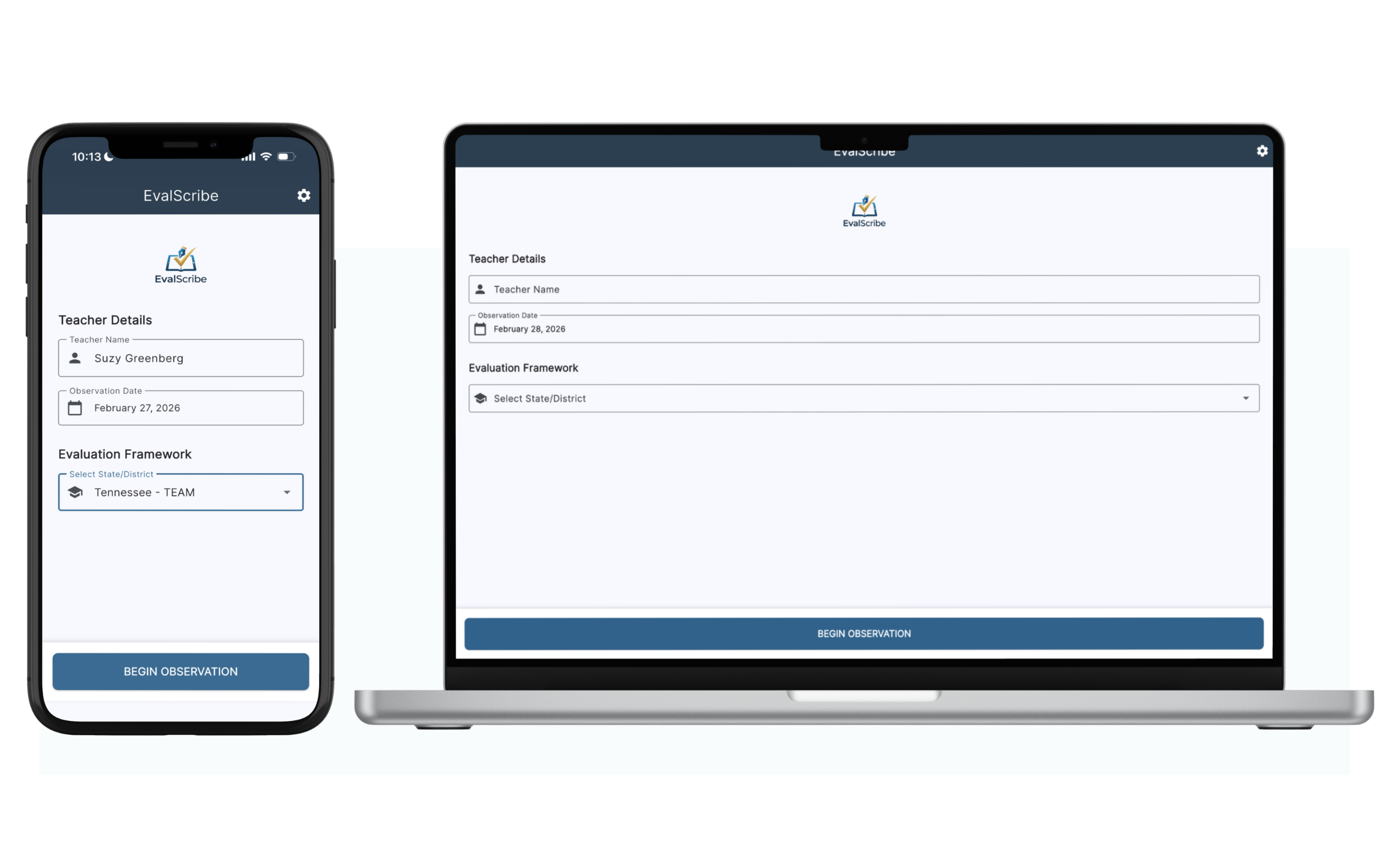
EvalScribe runs natively on iPhone, iPad, and Mac — work where you are.
Capture notes the way you already work.
No retraining required. Whatever your walkthrough style, EvalScribe accepts it.
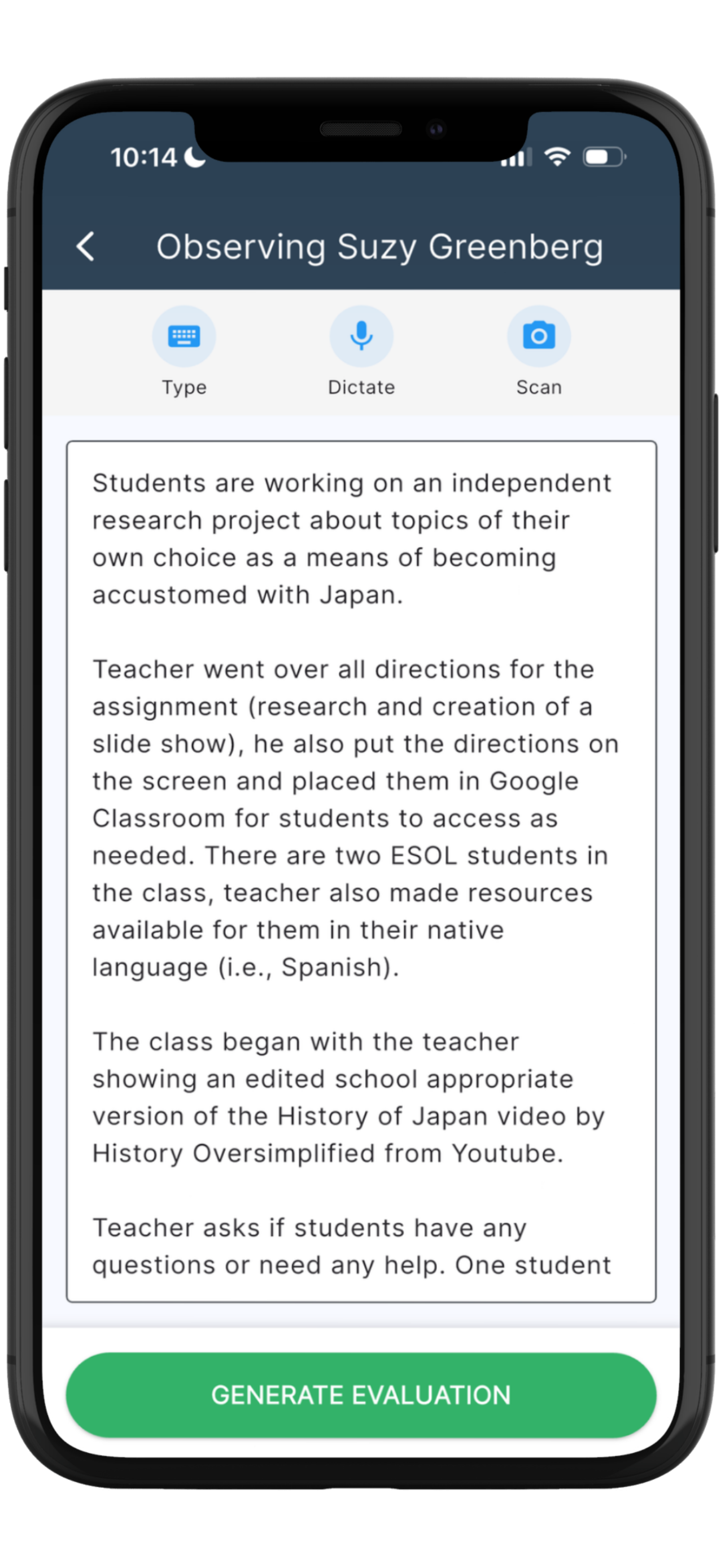
Snap a photo
Photograph your handwritten notes mid-walkthrough. Smart Scan OCR converts handwriting to text — even messy handwriting, even pedagogical terms.
Dictate as you go
Speak observations directly into the app. Voice dictation captures what you saw without breaking your eye contact with the classroom.
Type directly
Prefer to type? Enter notes straight into the app — they flow into the same DC-aware drafting pipeline as scans and dictation.
Why generic AI falls short for the Colorado State Model.
Pasting your walkthrough notes into a general-purpose chatbot might produce a paragraph that sounds polished — but for Colorado State Model documentation, "sounds polished" isn't the bar. Defensible, standards-aligned evaluations are.
| Capability | Generic AI (ChatGPT, Claude, etc.) | EvalScribe |
|---|---|---|
| Framework awareness | ✕No concept of the Colorado State Model, its four Quality Standards, or its four rating levels. Treats every prompt the same. | ✓Built around the four Teacher Quality Standards and the Highly Effective-to-Ineffective scale. |
| Element mapping | ✕Invents standard and element labels and rubric language that don't match the Colorado rubric. | ✓Maps evidence to the real elements of the Quality Standards using the actual rubric loaded into the app. |
| Scope of the score | ✕Assumes the observation is the whole rating, ignoring the separate Measures of Student Learning. | ✓Drafts the professional-practice piece (70%); leaves MSLs and the final combination to your district's process. |
| Current weighting | ✕May assume the old 50/50 split rather than the current emphasis on professional practice. | ✓Reflects the 70/30 professional-practice/MSL split in effect since 2023-24. |
| Rating levels | ✕Defaults to generic good-to-bad framing that misses Colorado's levels. | ✓Drafts toward Colorado's four levels — Highly Effective, Effective, Partially Effective, Ineffective. |
| Note input | ✕Requires you to retype everything before the AI can do anything with it. | ✓Accepts typed notes, dictation, or photos of handwritten notes via Smart Scan OCR. |
| Feedback language | ✕Vague, generic comments that could describe any teacher. | ✓Professional, evidence-anchored feedback written in the language of the Colorado Quality Standards. |
| Data privacy | ✕Free tiers may use your inputs to train public models. | ✓Enterprise-grade Microsoft Azure. Transient processing. Zero retention. Never used for training. |
| Defensibility | ✕Output you can't trace back to evidence or rubric language. | ✓Every comment is tied to evidence pulled from your notes and the component it supports. |
How much Colorado evaluation time could you reclaim?
Tune the inputs to your reality. The numbers update as you go.
You could reclaim approximately
hours per year
Workdays reclaimed
Total evaluations
Based on early EvalScribe users saving an average of 35 minutes per evaluation. Individual results may vary based on your current workflow.
The best way to see it
is to watch it.
Reading about how EvalScribe drafts a Colorado State Model evaluation isn't the same as watching it happen. The demo walks through a real observation — capture, mapping, scoring, and final export — start to finish.
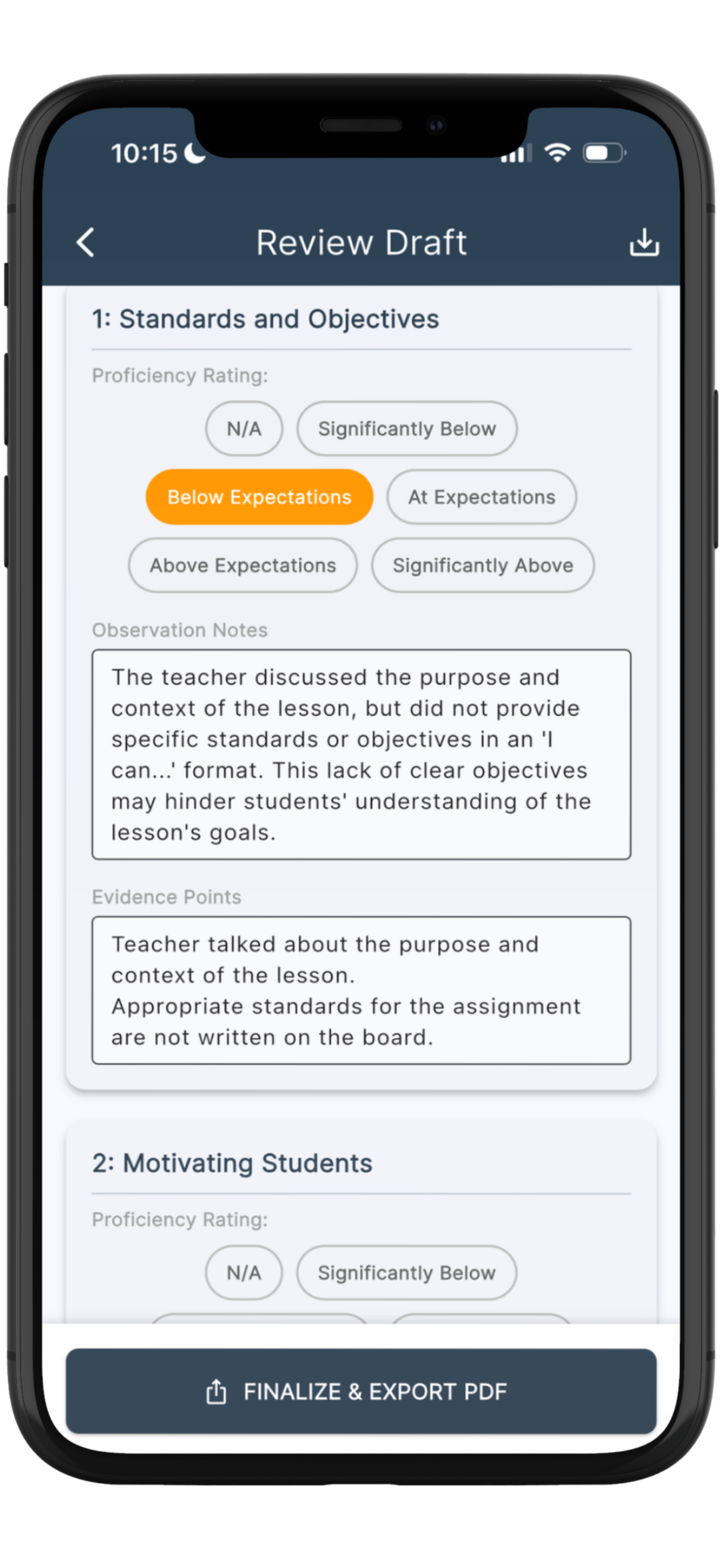
The draft review screen — every comment, rating, and piece of mapped evidence is fully editable before export.
See an example EvalScribe report.
A real EvalScribe-generated evaluation, formatted exactly as it exports from the app. The workflow is the same across frameworks — useful to share with district stakeholders.
Download sample PDFWhat educational leaders are saying.
Real feedback from administrators across roles — from academic coaches to assistant superintendents.
EvalScribe is a tool that every public school principal should use. This resource literally makes multiple people out of administrators, allowing them to focus their energies on precise observation analysis and quality feedback while leaving EvalScribe to handle the mechanics. This tool will remove virtually all of the drudgery from the classroom evaluation process and would represent an excellent use of school funds.
Dr. Robert Stinson
Principal
After seeing a detailed demonstration of EvalScribe, I came away very impressed with both the concept and the execution. The platform provides administrators with a practical way to quickly capture classroom observations and generate high-quality, customized feedback that remains aligned to their evaluation framework and local expectations. What stood out most was the balance between efficiency and quality. EvalScribe has the potential to reduce administrative workload while helping school leaders provide more timely and meaningful feedback to teachers — a tool with considerable promise for schools and districts.
Glenn Brown
Director of Student Services
Game changer. Absolute game changer for school admin.
Tobin Davidson
Assistant Superintendent · 40+ years in education
This is amazing. I would pay lots of money for this. I’m serious — it’s crazy good. I look forward to using it on a regular basis next year.
Kittie Brown
Assistant Principal
Evaluators spend an inordinate amount of time recording and documenting evaluations. This app is easy to use, affordable, and incredibly efficient. It cuts the time spent recording and documenting evaluations down significantly and frees us up to handle other aspects of the job. Plus, the conference suggestions save on prep time when a conference is warranted.
Angie Brandt
Academic Coach
Built by educators, for educators.
EvalScribe was co-founded by a practicing classroom teacher and his wife — a husband-and-wife team with thirty years of combined classroom and business experience.

Anthony Neely, Ph.D.
Co-founder · Product
A tenured K–12 classroom teacher and Professional Learning Lead. District Teacher of the Year, with nearly 20 years in education and three published books.

Andrea Neely, Ph.D.
Co-founder · Business
Associate Professor of Management. Research and teaching in organizational management.
Your evaluation data stays yours.
Observation notes are processed transiently on Microsoft Azure and are not retained on our servers. Your evaluation records live locally on your device. Notes and evaluations are never used to train public AI models. For districts needing a Data Processing Agreement or FERPA attestation, those are available on request.
Simple, transparent pricing.
Try EvalScribe with three free evaluations. When you're ready to keep going, pick the plan that fits your role.
Individual
For a single evaluator on their own device.
Billed annually per user
- Unlimited evaluations
- All supported frameworks, including the Colorado State Model
- iOS & macOS access
- 3 free evaluations to start
School-wide
For a school with multiple evaluators.
3+ evaluators
- Everything in Individual
- 10% volume discount
- Unique access code issued to your school
- Easy distribution to your evaluators
District-wide
For districts deploying across every evaluator.
Best value for full deployments
- Everything in School-wide
- 20% volume discount
- Single access code for the entire district
- Direct support contact for rollout
All pricing shown is introductory and may change. For school and district plans, EvalScribe issues a unique access code that the buyer distributes to their evaluators.
The Colorado State Model & EvalScribe — common questions.
Does EvalScribe support Colorado's State Model Evaluation System?
Yes. EvalScribe is built around the four Teacher Quality Standards — Content Knowledge, Learning Environment, Facilitation of Learning, and Professionalism — measured through Colorado's state rubric. It maps your observation evidence to the element it supports and drafts a rating and feedback for each, using the rubric's own language across the four levels (Highly Effective, Effective, Partially Effective, Ineffective).
How much of a Colorado teacher's evaluation is professional practice?
Beginning in 2023-24, under SB 22-070, professional practice — the four Quality Standards — makes up 70% of the Final Effectiveness Rating, and Measures of Student Learning/Outcomes make up the remaining 30%. This changed from the earlier 50/50 split, shifting the emphasis toward professional practice. EvalScribe drafts the professional-practice piece.
Does EvalScribe calculate my Final Effectiveness Rating?
No. EvalScribe drafts the professional-practice portion — the Quality Standard ratings and evidence-anchored feedback from your observations. The Measures of Student Learning/Outcomes and the combination of both portions into the Final Effectiveness Rating are handled in your district's scoring process, not the app.
Can I use EvalScribe if my district uses its own evaluation system?
Often, yes. Colorado's State Model is an option, not a mandate — districts may use it or adopt their own system that meets State Board rules and is built on the Colorado Teacher Quality Standards. Because EvalScribe is built around those Quality Standards and the state rubric, it fits either path. Confirm your district's adopted system, and email [email protected] to check a specific local rubric.
What are the Colorado rating levels?
Colorado uses four: Highly Effective, Effective, Partially Effective, and Ineffective. Non-probationary status is earned through consecutive effective-or-higher ratings and can be lost after consecutive ineffective or partially effective ratings, so the rating carries real weight. EvalScribe drafts toward these four levels using the rubric's own criteria.
Does EvalScribe replace evaluator judgment?
No. EvalScribe drafts evidence-mapped evaluations and suggested ratings. The evaluator reviews, edits, and finalizes every document. The professional judgment is always yours — EvalScribe just removes the typing.
Can the generated evaluations be edited?
Yes, fully. Every comment, every rating, and every piece of mapped evidence inside a draft evaluation can be edited before you export the final PDF. You are always the last set of eyes on the document.
Is observation data stored?
Your notes are processed transiently on Microsoft Azure and are not retained on EvalScribe's servers. Your evaluation records sit locally on your device under a local-first architecture. Your data is never used to train public AI models. For more detail, see our Privacy Policy.
How is EvalScribe different from ChatGPT or Claude?
Generic AI tools have no built-in understanding of the Colorado State Model. They invent standards and elements, hand out Highly Effective freely, and produce vague comments that miss the rubric's level distinctions. EvalScribe is built around the four Quality Standards and the state rubric — and the evaluator workflow that surrounds them — from capture through final export.
Where can I read the official Colorado State Model sources?
The Colorado Department of Education maintains the Educator Effectiveness pages, including the State Model Evaluation System for Teachers and the revised rubric and scoring. The governing law is Senate Bill 10-191, with State Board rules at 1 CCR 301-87.
Which other frameworks are supported?
EvalScribe ships with frameworks from all 50 states and Washington D.C., plus general models such as Danielson, Marzano, Stronge, CEL 5D+, NIET, and Kim Marshall. The complete list is available at evalscribe.com/frameworks.
Don't see your question? Reach out via our contact page — we read every message personally.
Spend less time on paperwork.
Lead your building.
EvalScribe was built to help Colorado evaluators spend less time documenting evaluations and more time doing what matters: leading instruction, coaching teachers, and walking buildings.

Three evaluations free — no credit card · Available on iPhone, iPad, and Mac